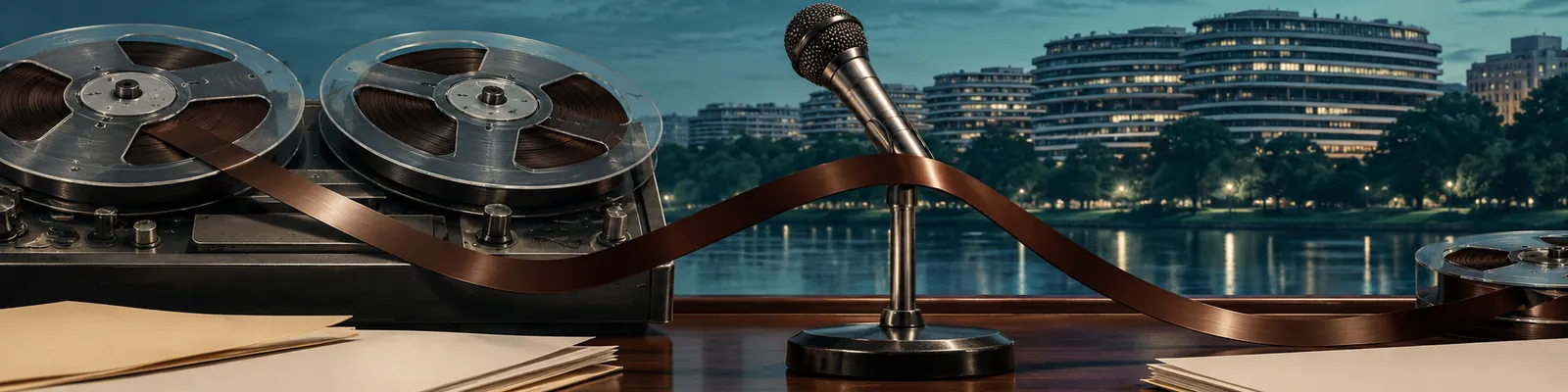
After five men were arrested inside the Democratic National Committee offices on June 17, 1972, a White House cover-up came to light through trials, a Senate committee, and a secret White House taping system, and ended when the Supreme Court ordered the tapes released and President Richard Nixon resigned on August 9, 1974.
In brief
On June 17, 1972, five men were arrested inside the Democratic National Committee offices at the Watergate complex. Five months later, President Richard Nixon won re-election with 60.7 percent of the vote, and voters did not know what would come out. Over the next two years, trials, a Senate committee led by Sam Ervin and Howard Baker, and a special prosecutor drew out the story. In July 1973 a White House aide told the nation there was a taping system in the Oval Office. A year later the Supreme Court ruled 8 to 0 that the President's privilege "must yield" to a specific need for evidence in a criminal trial. The tape of June 23, 1972 showed Nixon agreeing to limit the FBI's inquiry. He resigned on Aug. 9, 1974. A month later President Ford pardoned him, so no court ever decided the charges. The lesson is about records. The people had no means of seeing the key facts before they voted, and the means that did work were courts, subpoenas, divided power and an unplanned question.
The record
What we checked
Sources we opened: the National Archives page on the Watergate Special Prosecution Force (WSPF) records; the National Archives folder list on presidential tape recordings; the Senate Historical Office page on the Watergate Committee; United States v. Nixon, 418 U.S. 683 (1974), via Justia; Nixon's Aug. 5, 1974 statement and Ford's Sept. 8, 1974 pardon proclamation (American Presidency Project and Ford Library); the Miller Center page on the "smoking gun" tape and the Nixon Library finding aid for that tape; Public Law 93-443 at govinfo; Buckley v. Valeo, 424 U.S. 1 (1976), via Justia; a CUNY-hosted copy of the House Judiciary articles; Wikipedia pages on the scandal, the Watergate Seven, the Saturday Night Massacre, Alexander Butterfield and the 1972 election; a History.com page; and a transcript page of the 1977 Frost interview. Sources we could not open: the House Judiciary Committee's full 1974 report (govinfo link failed), the Senate committee's final report text, the WSPF final report, and the Britannica article (only its intro loaded). Several pages were returned as tool summaries, so we mark below where a secondary source carries a number.
Timeline
- Sept. 3, 1971: Plumbers burglarize the Los Angeles office of Daniel Ellsberg's psychiatrist, Lewis Fielding (Wikipedia, Watergate; see Case 06).
- June 17, 1972: Five men are arrested at the DNC offices in the Watergate complex (Senate Historical Office; NARA lists a security log for that date).
- Aug. 1972: A GAO audit refers $350,000 in questionable transactions to the Justice Department, which did not pursue them (Wikipedia; unverified against GAO).
- June 23, 1972: Oval Office conversation between Nixon and H. R. Haldeman about having the CIA tell the FBI to stop its inquiry. Haldeman: "the FBI is not under control." (Miller Center; Nixon Library log.)
- Nov. 7, 1972: Nixon re-elected, 60.7 percent of the popular vote and 520 to 17 in the Electoral College; turnout 56.2 percent (Wikipedia, 1972 election; not checked against the Clerk of the House).
- Jan. 1973: Seven indicted. Five plead guilty; G. Gordon Liddy and James McCord are convicted by a jury on Jan. 30, 1973 (History.com; Wikipedia).
- Feb. 7, 1973: Senate creates the Select Committee on Presidential Campaign Activities, 77 to 0 (Wikipedia; the Senate page confirms the Feb. 7 date). Sam Ervin (D-NC) chairs and Howard Baker (R-TN) is vice chair; members also Edward Gurney, Daniel Inouye, Joseph Montoya, Herman Talmadge, Lowell Weicker (Senate page).
- Mar. 21, 1973: White House counsel John Dean tells Nixon about the cover-up (Wikipedia). Mar. 23: Judge John Sirica reads a statement from McCord at sentencing (Wikipedia calls it a confession).
- Apr. 30, 1973: Dean is fired; Haldeman, John Ehrlichman, Jeb Magruder and Richard Kleindienst resigned in April (Wikipedia).
- July 13, 1973: Alexander Butterfield tells committee staff in a closed interview, "There is tape in the Oval Office" (Wikipedia, Butterfield). July 16, 1973: he says so in public, live on television.
- Aug. 9, 1973: The Senate committee sues for tapes and documents; the court dismisses for lack of jurisdiction (Senate page).
- Oct. 12, 1973: The D.C. Circuit upholds the special prosecutor's subpoena (Wikipedia, Saturday Night Massacre).
- Oct. 20, 1973: "Saturday Night Massacre." Attorney General Elliot Richardson and Deputy Attorney General William Ruckelshaus leave rather than fire special prosecutor Archibald Cox; Solicitor General Robert Bork, acting attorney general, fires him. At least 22 impeachment resolutions follow (Wikipedia).
- Nov. 1, 1973: Leon Jaworski appointed special prosecutor. Nov. 7, 1973: an 18 and a half minute gap is found on a June 20, 1972 tape. Rose Mary Woods said she erased it accidentally; forensic analysis found the erasure in at least five segments (Wikipedia; Nixon Library page).
- Feb. 19, 1974: Public hearings of the Senate committee end. June 27, 1974: final report (Senate page).
- Apr. 18, 1974: Jaworski's subpoena for specified tapes; Nixon moves to quash on May 1 and the district court denies it May 20 (U.S. v. Nixon).
- July 24, 1974: United States v. Nixon decided.
- July 1974: House Judiciary Committee adopts three articles: obstruction of justice (27 to 11), abuse of power (28 to 10), defiance of subpoenas (21 to 17) (CUNY page). We did not verify the exact day of each vote.
- Aug. 5, 1974: Nixon releases the June 23, 1972 transcripts and says he did not tell his staff or counsel about them, "a serious act of omission for which I take full responsibility."
- Aug. 9, 1974: Nixon resigns, before a full House vote on impeachment.
- Sept. 8, 1974: President Gerald Ford grants Nixon a pardon for offenses from Jan. 20, 1969 through Aug. 9, 1974 (Proclamation 4311).
- Oct. 15, 1974: Federal Election Campaign Act Amendments of 1974 (P.L. 93-443) signed.
- Feb. 21, 1975: John Mitchell convicted of conspiracy, obstruction and perjury; Haldeman and Ehrlichman also convicted in 1975 (Wikipedia, Watergate Seven; exact dates not given there).
Key documents
United States v. Nixon (July 24, 1974). Chief Justice Burger wrote for the Court; Justice Rehnquist did not take part. The Court rejected an absolute presidential privilege: neither separation of powers "nor the need for confidentiality of high-level communications, without more, can sustain an absolute, unqualified Presidential privilege of immunity from judicial process." The privilege "must yield to the demonstrated, specific need for evidence in a pending criminal trial." The grand jury had named Nixon an unindicted co-conspirator in March 1974, and the Court dismissed his challenge on that point as improvidently granted.
The June 23, 1972 tape. Nixon and Haldeman discuss having Walters and Helms of the CIA tell the FBI to stop. Nixon agreed to the plan, according to the Miller Center. The Nixon Library log notes Haldeman's talk of tracing money through a Miami bank and the instruction to say the matter could involve CIA operations. In his Aug. 5 statement, Nixon said the tapes showed that when he instructed coordination of the FBI and CIA, he also discussed "the political aspects of the situation."
Counts and records
- 69 people were charged, including two cabinet members, and most pleaded guilty or were convicted (Wikipedia). We did not confirm this against the WSPF final report.
- The WSPF records at the National Archives run from 1971 to 1977 and total 1,362 feet. Most are not online (NARA).
- Presidential recordings: the system recorded 3,432 hours from Feb. 16, 1971 to July 12, 1973 (Wikipedia). The Nixon Library says the tapes were first public through litigation, with seven tapes released to Judge Sirica on Nov. 26, 1973.
The law that followed
- The 1974 law set contribution limits ($1,000 per candidate per election for individuals, $25,000 per year in total), created the Federal Election Commission, and expanded disclosure (P.L. 93-443, as read).
- Buckley v. Valeo (Jan. 30, 1976) upheld the contribution limits and disclosure but struck the expenditure ceilings, including candidates' personal spending (Justia summary). So the post-Watergate system is partly what Congress wrote and partly what the Court left.
- The Senate committee's report also recommended a permanent special prosecutor and permanent congressional legal service; Congress enacted some of those, including the Ethics in Government Act (1978) (Senate page).
What this case shows
The question: what could ordinary people know, vote on and fix, and what happened when institutions failed them or hid the record?
- The election came before the facts. Voters chose on Nov. 7, 1972. The cover-up conversation of June 23, 1972 was not public until Aug. 1974. The trial of the burglars ended in Jan. 1973. Whatever a voter made of the break-in in 1972, the most important record existed only on a tape.
- The record existed by accident. The public learned there were tapes on July 16, 1973 because a committee staffer asked a witness about a suspicion. The system was secret, installed by the White House, and its contents were controlled by the person on them. Without that question, there would have been no way to test the competing accounts of Dean and Nixon.
- Courts, not voters, forced the disclosure. Nixon released edited transcripts of 43 conversations before the Court acted (U.S. v. Nixon). The decision said the President's privilege "must yield" to a specific need in a criminal trial. This is the key accountability fact: the rule that the President is answerable in court was decided by eight Justices on a record of subpoenas.
- The check that held was divided power. A grand jury, a judge (Sirica), a Senate committee, a special prosecutor, and the House Judiciary Committee each held part of the process. The Saturday Night Massacre shows what happens when one official tries to remove one of them: about 22 impeachment resolutions in days.
- Disclosure rules changed after, but not completely. The 1974 law required reports and created an enforcing commission. The Court upheld disclosure and contribution limits in Buckley. It left spending ceilings struck down. That is a fair record of what voters could and could not fix by statute.
- Clemency again ended the process before a court could decide. Ford's pardon, issued a month after the resignation, covered all offenses through Aug. 9, 1974. No court ever ruled on the underlying charges against Nixon. This is the same question Case 01 raises: when a pardon replaces a trial, the public record is less complete than a verdict would have made it.
The strongest objections, and our answers
- Objection: It was a partisan campaign by opponents and press. Reply: the House Judiciary Committee's articles passed with votes from both parties (27 to 11, 28 to 10, 21 to 17), and the Supreme Court was unanimous among the eight who sat. Former senior aides and campaign officials, including Mitchell, were convicted or pleaded (Wikipedia, Watergate Seven). We did not verify the party breakdown of the committee vote and do not claim it. The objection that there was intense partisan feeling is plain from the tight third article (21 to 17).
- Objection: Nixon did not order the break-in and was punished for a cover-up of other people's act. We found no document in what we read showing Nixon knew of the break-in in advance. The June 23, 1972 tape shows him agreeing to a plan to limit the FBI inquiry six days after the arrests. We state both: advance knowledge is not shown in the sources we opened; the obstruction is.
- Objection: Every politician cut corners; this was selective. Reply: the facts are in the record: use of the CIA to limit an FBI inquiry, hush money, and perjury convictions. We do not compare with other administrations on this page.
- Objection: The Ford pardon was right, because a trial would have divided the country. Ford's proclamation said a trial "could not fairly begin until a year or more has elapsed," that the nation's "tranquility" could be lost, and that Nixon had paid "the unprecedented penalty of relinquishing the highest elective office." Critics said no one should be above the law. We describe both. We did not open any poll or any 1974 hearing about the pardon; those are unverified.
- Objection: The gap proves a cover-up. Reply: not on the evidence we read. Woods said it was accidental; forensic work found multiple erasures; the Nixon Library page records both. Who did it is, as far as we read, not established. We do not use the gap as proof.
- Objection: Nixon later said he let it down; Nixon also said "when the president does it" nothing is illegal. We confirmed the quote, "Well, when the president does it ... that means that it is not illegal," in a transcript of the 1977 Frost interview (Teaching American History). We did not find the apology wording in the transcript we opened. We use the first only as Nixon's own view, not as law. The Supreme Court had held otherwise in 1974.
- Objection: It was a different era; no relevance now. Reply: this page makes no claim about the present. The point is the 1970s record of what disclosure and accountability existed.
Open questions: what would change our minds
- House committee details. We have vote counts from one university-hosted page. We did not read the committee report. Exact dates (late July 1974) and party breakdown are unverified.
- Total convicted. "69 charged, most convicted" is Wikipedia's summary. The WSPF final report would give the exact count by outcome; we could not open it.
- Haldeman and Ehrlichman sentences and dates. Wikipedia's Watergate Seven table does not give clear dates for them. Not verified.
- GAO referral. The Aug. 1972 audit claim comes from Wikipedia only.
- Senate report. We did not read the final report's findings or its recommendations beyond the Senate page's summary.
- Pardon reaction. We have the proclamation, not the 1974 reaction or any poll. Unverified.
- Butterfield's public question. We know the date and the closed interview; who asked in public is not stated in what we read.
- Tape gap cause. Not established in what we read.
- Pre-break-in knowledge. If a primary source such as a tape from before June 17, 1972 shows Nixon knew of the burglary plan, Objection 2 would change.
Sources
| Title | Publisher | Supports (opened?) |
|---|---|---|
| United States v. Nixon, 418 U.S. 683 (1974) | Justia (U.S. Reports) | Primary. Opened (via summary). Date, 8 to 0, privilege holding, subpoena facts |
| Watergate Special Prosecution Force records | National Archives | Primary. Opened. 1971 to 1977, 1,362 feet, Liddy case, tape records |
| Records on Presidential Tape Recordings (folder list) | National Archives | Primary. Opened. Gap and subpoena folders |
| Senate Watergate Committee | U.S. Senate Historical Office | Primary or official history. Opened. Dates, members, report June 27, 1974, recommendations |
| Statement of Aug. 5, 1974 announcing availability of additional transcripts | American Presidency Project | Primary. Opened. Nixon's admission |
| Smoking Gun tape, June 23, 1972 | Miller Center, University of Virginia | Secondary with transcript quotes. Opened |
| Tape subject log, June 23, 1972 | Nixon Presidential Library | Primary. Opened |
| White House tapes | Nixon Presidential Library | Primary. Opened. Tape release history, gap note |
| Proclamation 4311, Ford pardon (Sept. 8, 1974) | Gerald R. Ford Presidential Library | Primary. Opened. Scope and reasons |
| Public Law 93-443 (Oct. 15, 1974) | govinfo | Primary. Opened. Limits, FEC, disclosure |
| Buckley v. Valeo, 424 U.S. 1 (1976) | Justia | Primary. Opened (first 100,000 characters). Upheld and struck provisions |
| The articles of impeachment against Nixon | Brooklyn College (CUNY) | Secondary. Opened. 27 to 11, 28 to 10, 21 to 17 |
| Watergate scandal | Wikipedia | Secondary. Opened. Timeline, 69 charged, GAO referral |
| Watergate Seven | Wikipedia | Secondary. Opened. Mitchell, Haldeman, Ehrlichman, Colson outcomes |
| Saturday Night Massacre | Wikipedia | Secondary. Opened. Oct. 20, 1973, gap forensic |
| Alexander Butterfield | Wikipedia | Secondary. Opened. July 13 and 16, 1973 |
| 1972 United States presidential election | Wikipedia | Secondary. Opened. Vote shares |
| Watergate | History.com | Secondary. Opened. Seven indicted, five pleaded |
| Transcript of David Frost's interview with Richard Nixon | Teaching American History | Primary transcript. Opened. "when the president does it" |
Found an error or a better source? We keep every correction on the record with its date and reason. Nothing here is quietly rewritten.