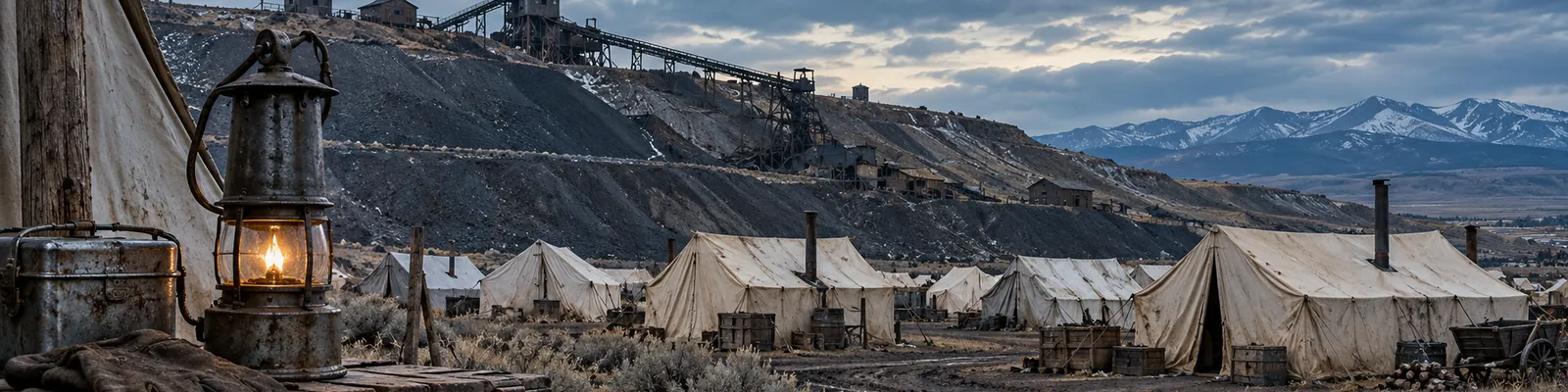
During a 1913-14 coal strike in southern Colorado, a battle between the Colorado National Guard and striking miners ended with the burning of the Ludlow tent colony and the deaths of about twenty people, including women and children; a federal report found that the coal companies had dominated local government in the strike counties.
In brief
In September 1913, thousands of coal miners in southern Colorado, many of them recent immigrants from Italy, Greece and Eastern Europe, went on strike against Colorado Fuel and Iron, a company whose main stockholder was John D. Rockefeller Jr., and other operators. Their demands included union recognition and enforcement of laws Colorado already had, such as the eight-hour day and the right to choose their own checkweighmen. Evicted from company towns, they lived in tent colonies. On April 20, 1914, a battle with the Colorado National Guard ended with the Ludlow colony in flames and about twenty people dead, including women and children who suffocated in a pit beneath a tent. A federal commission later found that the companies had for years controlled local officials, from election judges to sheriffs, in two southern Colorado counties. No guardsman was convicted, while the union's leader was sentenced to life before his conviction was overturned. Ludlow shows how economic power over a town can become power over its government and courts.
The record
Background: the coalfields and the companies
- 1910 to 1913: Coal mining employed "almost 16,000" Colorado residents in 1910. In 1912 the state's coal miner death rate was double the national average, and more than 100 men died in mine accidents by the end of 1913. Colorado Fuel and Iron (CF&I) employed about 7,000 workers and controlled nearly 70,000 acres; the NPS calls it "one of the worst violators of existing mine safety rules." (NPS, War in the Coalfields)
- CF&I was "the state's largest private employer," and John D. Rockefeller Jr. was its "primary stockholder." (Colorado Encyclopedia, Ludlow Massacre) The Samuel Gompers Papers describe CF&I as "a Rockefeller concern" and name Victor-American Fuel and Rocky Mountain Fuel as the other leading opponents of the union. (Samuel Gompers Papers, Univ. of Maryland)
- Company towns: The U.S. Commission on Industrial Relations (CIR) report found that "In many of the coal camps, the companies owned every house and every foot of ground," and that "Spies, camp marshals, and armed guards infested the mining camps" (p. 32). The Colorado Supply Company was "the company store department of the Colorado Fuel and Iron Company" (p. 24). (CIR, Report on the Colorado Strike, George P. West, 1915, Internet Archive)
- Workforce: The CIR report described the camps as "a small minority of English-speaking miners and their families and a majority of recently-arrived Europeans" (p. 10). An operator, Peabody, testified that operators were "taking our miners from southern Italy and northern Italy, the Hungarians and the Slavs" (p. 11). (CIR report) Strike leader Louis Tikas was "a Greek-American." (Colorado Encyclopedia)
Political control in the strike counties (CIR findings)
- The CIR report stated that "two entire counties of southern Colorado for years have been deprived of popular government" (p. 16). The sentence does not name them; the report's examples come from Las Animas County (Trinidad) and Huerfano County (Sheriff Jefferson Farr). (CIR report)
- Methods the report lists (p. 16): "the appointment of company officials as election judges," a "political partnership with the liquor interests," and company influence over "the choice of teachers, ministers of the gospel, election judges, and town and county officials." It says the purpose included the ability to "control coroners and judges and thus prevent injured employees from collecting damages," and to "obey or disregard state laws governing coal mining as they pleased." (CIR report)
- The one concrete election example in the report is testimony by CF&I executive L. M. Bowers that the company "turned 150 men out of its offices on election day to work for prohibition" (p. 20). The report gives no specific documented case of ballot fraud in these counties; its introduction argues that company towns could defeat self-government "without resort to illegal practices such as ballot box stuffing" (p. 7). (CIR report)
- Sheriffs: "In Huerfano County alone, 326 men, many imported from other states, had been commissioned as deputy sheriffs by Sheriff Jefferson Farr" (p. 32). Farr admitted he did not know whether they "might have been red-handed murderers" (p. 23). Mine guards were "employed and paid by the coal companies and deputized by subservient sheriffs" (p. 23). (CIR report)
- The report states its factual statements "will be based on testimony given before the Commission" at public hearings in Denver, New York and Washington (p. 15). It is an advocacy-toned staff report, signed "By GEORGE P. WEST." (CIR report)
The strike, 1913 to 1914
- September 23, 1913: The United Mine Workers of America (UMWA) struck the southern Colorado coalfields. (Gompers Papers; PBS American Experience) The CIR report says between 8,000 and 10,000 miners left the camps that day (p. 32). (CIR report) (The University of Denver's Ludlow project page gives September 30; the other sources agree on September 23.)
- The seven demands, per the University of Denver Ludlow archaeology project: "Recognition of the United Mine Workers of America"; "A 10% wage increase"; "Enforcement of the 8 hour day"; "Payment for dead work"; "Right to elect checkweighmen"; "The right to trade in any store, board anywhere, and use any doctor"; "Enforcement of Colorado mining laws and abolishment of armed mine guards." (University of Denver, Ludlow Collective, The Strike) The Gompers Papers give the same list. The CIR report charged that operators would "deny checkweighmen to the men in order that the miners might be cheated of part of their earnings" (p. 17). (CIR report)
- Evicted from company housing, strikers moved into tent colonies, including Ludlow. (NPS) The Ludlow colony held about 1,200 strikers and family members. (CU Boulder, Colorado Arts & Sciences Magazine, 2014)
- Operators brought in Baldwin-Felts guards, "many sworn in as sheriff's deputies." (Gompers Papers)
- Late October 1913: Gov. Elias Ammons declared martial law and sent in the National Guard; under Adj. Gen. John Chase the Guard protected strikebreakers. (Gompers Papers) Mine owners had "already worked out a deal with the state to pay for the cost of the deployment." (Colorado Encyclopedia) The CIR report says the company "created a private army of armed guards and later procured the enlistment of these gunmen in the militia" (p. 28). (CIR report)
- Early 1914: A subcommittee of the House Committee on Mines and Mining investigated; the strikers' brief was filed with it (CIR report p. 34). On April 6, 1914, Rockefeller Jr. defended the "open shop" before a congressional committee: "It is a great principle." (CIR report; PBS)
April 20, 1914, and the Ten Days' War
- April 20, 1914: "a battle broke out between the Colorado National Guard and striking coal miners" near Ludlow; who fired first is not known. (Colorado Encyclopedia) The fighting "raged for 14 hours." (PBS) The tent colony burned.
- The "death pit": women and children sheltering in a pit dug under a tent died. The CIR report says the burning caused "the death by suffocation and burning of thirteen women and children" (pp. 26-27). PBS says "two women and 11 children who suffocated in a pit," while noting a New York Times account of "the bodies of 10 children and two women." (CIR report; PBS)
- Louis Tikas was killed in custody. A doctor at the coroner's inquest testified that a rifle-stock blow from Lt. Karl Linderfelt "was so severe that it might have caused death," apart from three gunshot wounds (p. 27). (CIR report)
- After Ludlow, labor leaders urged workers to arm, and retaliatory violence spread. (Gompers Papers) Fighting lasted ten days from Trinidad to Walsenburg. (CU Boulder)
- April 28 to 29, 1914: President Woodrow Wilson sent federal troops, at Gov. Ammons's request, to disarm both sides. (Colorado Encyclopedia gives April 28; Gompers Papers gives April 29; NPS)
- December 10, 1914: The UMWA called off the strike, after operators rejected Wilson's settlement efforts. (Gompers Papers) The union achieved "none of its stated objectives." (Colorado Encyclopedia)
Disputed numbers: deaths
| Figure | What it counts | Source checked |
|---|---|---|
| "At least nineteen": one guardsman, five miners, thirteen women and children | April 20 at Ludlow | Colorado Encyclopedia |
| 21, "including 11 children" | April 20 at Ludlow | NPS |
| "20 colonists" | April 20 at Ludlow | University of Denver |
| "at least five miners, two women, and eleven children" | April 20 at Ludlow | Gompers Papers |
| 19 to 26 | April 20 at Ludlow | CU Boulder, 2014 |
| "estimated from 69 to 199" | Final toll of the ten days of fighting (source not named) | CU Boulder, 2014 |
Pit victims: two women and eleven children (PBS, Gompers), "three women and eleven children" killed at Ludlow (History Matters headnote), or "thirteen women and children" (CIR). The safest statement: about 20 people died at Ludlow on April 20, including about a dozen children; total deaths for the wider fighting are estimated at roughly 69 to 199.
Investigations and the Rockefeller response
- January 26, 1915: Rockefeller Jr. testified before the CIR in New York. (PBS) May 20 to 22, 1915: he testified again in Washington under questioning by Chairman Frank Walsh. (History Matters, GMU, reproducing New York Times coverage) The CIR report says he testified he had "not the slightest idea" what wages miners received or what rent the company charged, and had not visited Colorado in ten years (pp. 35-36). (CIR report)
- 1915: Rockefeller, advised by W. L. Mackenzie King (later prime minister of Canada), introduced at CF&I "one of the nation's first employee representation plans." The Rockefeller Plan lasted until 1942 and "became the model for ERPs all over the world." Historian Jonathan Rees judges it "a limited but temporarily effective alternative to independent unionism." (Rees, Representation and Rebellion, Univ. Press of Colorado, 2010, Project MUSE; Colorado Encyclopedia) On September 20, 1915, Rockefeller told miners in Colorado, "Capital can't get along without you men, and you men can't get along without capital"; John Lawson said he was "trying to substitute paternalism" for unionism. (PBS)
Prosecutions
- Guardsmen: A general court-martial at Golden, May 11 to 29, 1914, tried 21 men on 63 charges. All were "acquitted and exonerated" in findings approved by Gov. Ammons. Linderfelt was found to have struck Tikas with a rifle, but the court "attaches no criminality thereto." (Lincoln Evening Journal, Aug. 25, 1914, and court-martial findings, reproduced by Hellraisers Journal) The CIR report characterized the result as "trifling demotions in rank" (p. 28) and said no steps were taken to prosecute Linderfelt in civil court (p. 27). (CIR report)
- Strikers: In August 1914 a Trinidad grand jury, under Attorney General Fred Farrar, indicted 124 strikers and strike leaders. Per John A. Fitch's account in the CIR report, jurors included two deputy sheriffs (one in charge of deputies who attacked the Forbes colony), the father of a deputy, a former employee of CF&I's store department, and the secretary to a coal company president (pp. 24-25). (CIR report)
- John R. Lawson, UMWA leader, was convicted of first-degree murder (the killing of guard John Nimmo) and sentenced to "life imprisonment at hard labor"; the CIR noted "No effort was made to prove that he fired the fatal shot." The trial judge, Granby Hillyer, had been a CF&I attorney before his appointment; the jury panel "was selected by the Sheriff of Las Animas County" (pp. 22-24). (CIR report)
- June 4, 1917: The Colorado Supreme Court unanimously reversed Lawson's conviction on the defense objection to the trial judge, and remanded to Las Animas County. (United Mine Workers Journal, June 7, 1917, reproduced by Hellraisers Journal)
Legacy
- 2009: The Department of the Interior designated the Ludlow Tent Colony Site a National Historic Landmark, one of two such sites tied to American labor history at the time, following work by the Colorado Coal Field War Archaeological Project (co-directed by Dean Saitta of the University of Denver). (Colorado Encyclopedia; CU Boulder) The site is owned by the UMWA; NPS awarded a $91,260 Preservation Planning Grant for a site master plan. (NPS)
What this case shows
- Federal investigators found local self-government had been displaced by employers. A U.S. government commission reported that "two entire counties of southern Colorado for years have been deprived of popular government," citing company officials serving as election judges and company influence over county officials, coroners and judges. (CIR report)
- The machinery of law was privately staffed. One Huerfano sheriff commissioned 326 deputies, many from out of state and paid by the companies; mine guards were then enlisted in the militia; operators arranged to pay for the Guard deployment. Workers faced armed force wearing public badges. (CIR report; Colorado Encyclopedia)
- Unequal access to justice. Guardsmen were judged by fellow officers and all acquitted; 124 strikers were indicted by a grand jury that included deputy sheriffs and people tied to coal companies; the union leader was convicted of murder before a former company lawyer without proof he fired a shot. Redress came three years later from the state supreme court. (Court-martial findings; CIR report; UMWJ 1917)
- Workers had to strike to get existing law enforced. Several demands asked only for enforcement of Colorado law (eight-hour day, checkweighmen, mining laws). The CIR found operators chose to "ignore or defy state laws enacted to safeguard the interests of their employees." When legal rights depend on political power, the less powerful lose them in practice. (University of Denver; CIR report)
- Immigrant workers were described as unfit to govern themselves. The CIR reported the argument that camp residents, "being largely of foreign birth and speech," were incapable of self-government, and rejected it as "the political philosophy that justified slavery half a century ago." (CIR report)
The strongest objections, and our answers
- Objection: The link to voting is indirect. Mitigation: Agreed. The strike was about wages, safety, and union recognition, not the ballot. The tie is political voice: who controlled county offices, deputies, and juries. We did not verify how many miners were non-citizens and so ineligible to vote; that should not be asserted as a number.
- Objection: The CIR report is one-sided. Mitigation: Fair. West's report is openly critical of the operators, and the commission's chair was pro-labor. It does cite sworn testimony (Farr's 326 deputies, Bowers's election-day statement, Rockefeller's "not the slightest idea"). We present its sweeping claims as findings of the report, not as settled fact, and note that it gives no specific documented case of election fraud.
- Objection: Strikers were armed and killed people too. Mitigation: True. Strikers armed themselves, a guardsman died at Ludlow, and after Ludlow strikers attacked mines and guards. Who fired first on April 20 is unknown. The argument does not depend on strikers being blameless; it concerns who controlled courts and force, and the deaths of women and children who were not combatants.
- Objection: Death counts vary widely. Mitigation: We give the range. About 20 died at Ludlow on April 20 in every source checked; the wider total ranges from 69 to 199 in one academic summary whose original estimators we did not identify.
- Objection: The system corrected itself. Mitigation: Partly. Lawson's conviction was reversed, federal troops ended the fighting, and federal hearings exposed the facts. But no guardsman was held criminally responsible, the union lost, and correction came from outside the local system after years.
- Objection: The Rockefeller Plan gave workers a voice. Mitigation: It created a company-sponsored channel. Rees calls it "limited but temporarily effective"; it was an alternative chosen by the employer, not independent representation. Fair to say it was a real, if limited, change.
Open questions: what would change our minds
- Naturalization data for Huerfano and Las Animas miners in 1913-14 (census or CIR testimony) would show how many could vote at all. Not found.
- Primary documentation of specific election irregularities in these counties (for example, contested-election rulings or legislative investigations) would strengthen or weaken the CIR's general claim. Not found.
- The original source of the 69 to 199 total death estimate should be identified (possibly Thomas Andrews, Killing for Coal, 2008, or earlier counts).
- The exact statutes the miners sought to enforce (year of Colorado's eight-hour law for coal mines and the checkweighman law) were not verified from statute text.
- The final disposition of Lawson's case after remand (expected nolle prosequi) was not confirmed from a primary source, and the Colorado Supreme Court opinion itself was not located.
- Whether Linderfelt received any administrative reprimand or demotion despite acquittal: the court-martial findings say acquitted; the CIR says "trifling demotions." A full record would resolve this.
Sources
| Title | Publisher | Supports |
|---|---|---|
| War in the Coalfields: The Ludlow Massacre and its Impact on the Eight-Hour Workday | National Park Service | Industry and safety figures, CF&I size, evictions, 21 killed, federal troops, NHL, NPS grant |
| Report on the Colorado Strike (George P. West, 1915) | U.S. Commission on Industrial Relations, via Internet Archive | Political control, election judges, deputies, juries, immigrants, death pit, Lawson trial, court-martial, Rockefeller testimony |
| Ludlow Massacre | Colorado Encyclopedia | CF&I and Rockefeller, Guard paid by operators, at least 19 dead, federal troops, Rockefeller Plan, NHL 2009, strike outcome |
| Colorado Coal Strike 1913-14 | Samuel Gompers Papers, University of Maryland | Strike dates, demands, Baldwin-Felts deputies, martial law, death figures, end date |
| The Strike | University of Denver, Ludlow Collective | Seven demands verbatim, 20 colonists killed |
| Scholars explore Ludlow Massacre on its centennial (2014) | University of Colorado Boulder, Colorado Arts & Sciences Magazine | 1,200 colonists, 19-26 dead, 69-199 total, NHL 2009 |
| The Rockefellers and Ludlow | PBS American Experience | Strike date, pit deaths, 1914 and 1915 testimony, 1915 visit |
| Rockefeller testimony, May 1915 (New York Times excerpts) | History Matters, George Mason University | Washington testimony May 20-22, 1915; Walsh |
| Representation and Rebellion (Jonathan Rees, 2010) | University Press of Colorado, via Project MUSE | Rockefeller Plan, King, 1915 to 1942, evaluation |
| Court-martial findings and Lincoln Evening Journal, Aug. 25, 1914 | Reproduced by Hellraisers Journal | 21 guardsmen, 63 charges, all acquitted, Linderfelt finding |
| United Mine Workers Journal, June 7, 1917 | Reproduced by Hellraisers Journal | Lawson conviction reversed June 4, 1917, unanimous, remanded |
Found an error or a better source? We keep every correction on the record with its date and reason. Nothing here is quietly rewritten.