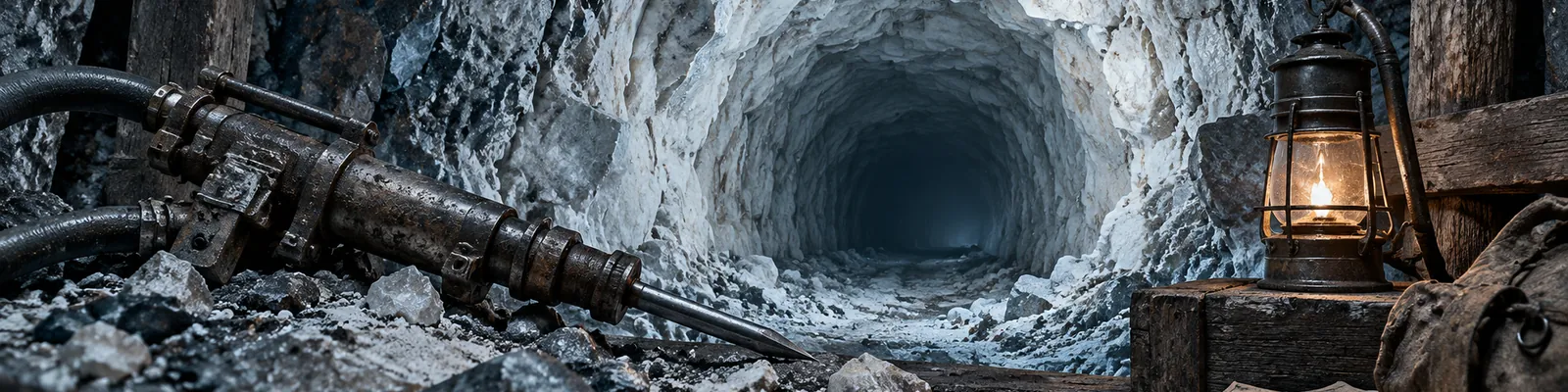
Thousands of mostly migrant, mostly Black workers drilled a hydroelectric tunnel through nearly pure silica rock in 1930 to 1931 with little dust protection; the number who died is uncertain, with estimates from 109 to about 2,000, and a 1936 House inquiry could not compel the contractors to testify.
In brief
Between 1930 and 1931, thousands of workers, most of them Black men who had migrated from the South, drilled a three-mile tunnel through nearly pure silica rock in West Virginia to power a Union Carbide metals plant. Many breathed fine silica dust, and many died of silicosis. In 1936 a House subcommittee held hearings, but it could not compel the contractor's officials, who declined to appear. How many died is still unsettled. A company estimate on the state marker says 109, a congressman said 476, a historian estimated at least 764, and some estimates run near 2,000. Some of the dead were buried in unmarked graves, and some families never learned the cause. Hawks Nest shows what happens when the people at risk cannot see the record that would prove what was done to them.
The record
The project and the work
- Union Carbide formed the New Kanawha Power Company in 1927 as a wholly owned subsidiary. Rinehart and Dennis, a contractor from Charlottesville, Virginia, began construction on March 31, 1930. It was the lowest of 35 bidders. A tunnel about three miles long ran through Gauley Mountain between Ansted and Gauley Bridge. Its water powered a metals plant at Alloy, West Virginia, run by Union Carbide's Electro-Metallurgical Company. (Wikipedia, Hawks Nest Tunnel disaster; NPS, New River Gorge; both opened)
- The project was licensed as civil engineering, so mine safety enforcement did not apply. (West Virginia Encyclopedia; opened)
- Workers: NPS says about 5,000 worked on the project and an estimated 2,900 inside the tunnel, with at least two-thirds African American. NPR says nearly 3,000 workers on shifts of 10 to 15 hours, roughly three-quarters Black migrants. Wikipedia gives a different count: 4,800 men, 1,700 white and 3,100 Black, with only 738 white men underground. (NPR via Connecticut Public, 2019; opened)
- Pay and conditions: Wikipedia says Black workers were paid less than white workers and paid in scrip. Black workers told Congress in 1936 that they were denied breaks and forced to work at gunpoint by "shack rousters." The Wikipedia entry does not link each claim to a specific source; it is a summary.
- A Union Carbide report said that 80% of workers became ill, died or left within six months. (Wikipedia; NPR)
- Company doctors often attributed deaths to "tunnelitis." Dewey Flack, a 17- or 18-year-old Black worker from North Carolina, died May 20, 1931; his death certificate listed pneumonia. His niece, Sheila Flack-Jones, said the family never learned the truth. (NPR)
Timeline
| Date | Event | Source |
|---|---|---|
| 1927 | New Kanawha Power Company formed | Wikipedia |
| March 31, 1930 | Rinehart and Dennis begins construction | Wikipedia |
| 1930 to 1931 | Tunnel bored in about 18 months (NPR); one 1936 newspaper says 30 months | NPR; WV Archives (newspaper) |
| May 20, 1931 | Death of Dewey Flack | NPR |
| 1932 | Cora Jones (named "Dora Jones" in one law blog) files a claim against Rinehart and Dennis | Wikipedia; HeinOnline blog |
| 1933 | First major trial ends with a hung jury after nearly 170 witnesses (Wikipedia); West Virginia Supreme Court case Jones v. Rinehart, 113 W.Va. 414 (HeinOnline blog) | Wikipedia; HeinOnline |
| 1933 to 1934 | Two trials in Fayetteville and Charleston; jury tampering evidence; large fees to plaintiffs' lawyers | West Virginia Encyclopedia |
| January 16, 1936 | Subcommittee hearings begin | WV Archives (Congressional record text) |
| January 17, 1936 | Rep. Vito Marcantonio raises the issue on the House floor | WV Archives (newspaper) |
| February 4 to 5, 1936 | Hearings end Feb. 4; report dated Feb. 5, signed by Glenn Griswold (chair), Marcantonio, W. P. Lambertson and Matthew A. Dunn | WV Archives (Congressional record text) |
| April 1, 1936 | House debate | WV Archives (Congressional record text) |
| 1938 | Muriel Rukeyser publishes The Book of the Dead | Wikipedia |
| 1986 | Martin Cherniack's The Hawk's Nest Incident (Yale); state historical marker | Wikipedia |
| 2012 | Memorial dedicated | Wikipedia |
Congress, 1936
- The House Labor Committee subcommittee held hearings from January 16 to February 4, 1936, and issued a report on February 5. The West Virginia Encyclopedia lists the hearings as House Joint Resolution 449, 74th Congress, second session. The subcommittee lacked subpoena power. Contractor officials P. H. Faulconer and E. J. Perkins declined to appear, saying they knew of no silicosis deaths on the project. Dr. Hayhurst, who had studied Gauley Bridge workers, declined to testify. (WV Archives, text of the 1936 House proceedings and report; opened. We treat it as a transcription of the Congressional Record; the page does not say so itself.)
- The February 5 report says many workers became infected and died, but gives no number. (same)
- Quoted by a law-library blog from the report: "grave and inhuman disregard" for workers' health, cited to 80 Cong. Rec. 4720. The blog also quotes testimony by George Robinson, a Black driller, that sheriffs forced sick workers out of town. (HeinOnline blog, Jan. 2024; opened; quote not checked against the original)
- The contractor's president, P. H. Faulconer, said there were "fewer deaths than there might be in a community of comparable size" among about 5,000 workers, and called silicosis suits "rackets." (WV Archives, June 26, 1936 newspaper)
Disputed numbers: deaths
| Figure | Who said it, when | What it counts | Source opened | |---|---|---| | 109 | Union Carbide estimate on the state historical marker | Deaths 1930 to 1935 | Wikipedia (marker itself not opened) | | "250 to 300" | Rep. Matthew Dunn's question on the House floor; Rep. Griswold replied "true of the Gauley Bridge situation" | Deaths "within a period of 2 or 2 1/2 years"; the page says it is not a verified count | WV Archives, 1936 House text | | "Up to 300" | Congressional testimony, per NPR | Silicosis deaths | NPR | | 476 | Marcantonio, Jan. 1936 (with about 1,500 silicosis cases) | Deaths attributed to the tunnel; the marker and the West Virginia Encyclopedia say the toll was "placed" at 476 in the 1936 House hearings | WV Archives, 1936 newspaper; West Virginia Encyclopedia | | At least 764 (some sources: "as many as 764") | Martin Cherniack, 1986 | Deaths from silicosis and related conditions | NPS; West Virginia Encyclopedia | | "Close to 1,000" | NIOSH study, 2002, per the encyclopedia | Deaths | West Virginia Encyclopedia (NIOSH not opened) | | Up to 2,000 | Stretesky and Lynch, 1999, per HeinOnline blog | Deaths, "in some estimates" | HeinOnline blog |
Notes on the table: The 476 figure is a claim made in Congress by Marcantonio; the subcommittee's own February 5 report, as we read it, gives no number. We cannot say what method produced 476. Cherniack's 764 includes some workers whose deaths he inferred; we did not read his book. Wikipedia and a West Virginia Archives page both say no definitive count exists because many sick Black workers left the region. We do not pick one figure. The NPS uses "at least 764" without naming the estimator.
Burials
- Marcantonio charged that 169 workers who died of silicosis were buried in a cornfield, with "cornstalks" as markers. H. C. White, a Summersville undertaker, said he buried 27 Black workers in a private cemetery. NPR reports about 40 men in a mass grave on a farm, later reburied at Whippoorwill Cemetery in Summersville in the 1970s, and undertakers paid $50 a body. Wikipedia says the remains were disinterred in 1972 during road widening. (WV Archives newspapers; NPR; Wikipedia)
Lawsuits and money
| Figure | Source | Notes |
|---|---|---|
| 538 suits seeking $4 million | Wikipedia; West Virginia Encyclopedia gives 538 suits, no total | |
| $130,000 settlement; lawyers took 50% | Wikipedia | After the 1933 hung jury |
| $200,000 settlement; individual awards $30 to $1,600 | West Virginia Encyclopedia | |
| $170,000 to settle 300 cases, plus $166,000 paid to the state compensation fund | WV Archives, June 26, 1936 newspaper | Silicosis was not covered by the compensation law then; West Virginia later made it compensable |
| 200 more suits thrown out by the West Virginia Supreme Court | Same newspaper; another 1936 paper says "more than 200" and cites the time limit |
The settlement totals do not agree ($130,000, $170,000 plus $166,000, $200,000). They may count different things; we did not find a primary settlement record. Wikipedia and the HeinOnline blog say neither company, nor its employees, faced criminal or civil accountability or admitted fault.
Aftermath
- Matthew Watts, Catherine Venable Moore, Charlotte Yeager and others later worked to find and mark graves. (NPR)
- NPR says Congress passed a law requiring respirators in dusty conditions in 1936; the HeinOnline blog names the Walsh-Healey Act (1936) for federal contractors and says Frances Perkins convened a national silicosis conference. We did not open the statute.
What this case shows
- The people with the most at stake had the least say. At least two-thirds of the recruited workers were Black, many were migrants, and the project was licensed as civil engineering outside mine safety rules. They could not vote on the license, the dust, or the burial. (NPS; West Virginia Encyclopedia)
- The facts were not available even after the hearing. The House subcommittee could not subpoena the contractor, and the contractor's executives declined to appear and said they knew of no silicosis deaths. The report gave no death count. The public got figures from a congressman's floor speech, newspapers and a state marker that disagree by more than a factor of four. (WV Archives, 1936 House text)
- Access to a court, and to a lawyer, was unequal. The first trial ended in a hung jury, with evidence of jury tampering (West Virginia Encyclopedia). Settlement awards ran from $30 to $1,600, and lawyers took half in one account. More than 200 suits were dismissed on a time limit; plaintiffs said they did not learn they had silicosis until months after they left. (WV Archives, Jan. 1936 newspaper)
- Records were lost or never made. Death certificates named pneumonia or "tunnelitis"; some dead were buried in unmarked graves; the HeinOnline blog says records were later reported "lost." A family could not learn what happened to Dewey Flack. (NPR; HeinOnline blog)
- A public hearing did change policy, slowly. The inquiry led to a national silicosis conference and later changes in state compensation law (HeinOnline blog; NPR). This shows what open inquiry can do, and how late it came.
The strongest objections, and our answers
- Objection: The death toll is too uncertain to build an argument on. Mitigation: Agreed that we cannot give one number. The argument does not need one. It needs the fact that estimates range from 109 to about 2,000, and that the range is the finding about the record.
- Objection: Union Carbide's low estimate and the contractor's statement are being dismissed. Mitigation: We report both: the 109 estimate on the marker and Faulconer's claim of "fewer deaths than there might be in a community of comparable size." We could not read the company's own 1936 report. Treat the company position as incompletely documented here.
- Objection: 476 and 764 are advocacy numbers. Mitigation: Fair. 476 came from a congressman, and the report we read does not repeat it. 764 comes from an epidemiologist's historical estimate, not a count of named people. We label each by who made it.
- Objection: The workers were paid and took the jobs willingly; this was the Depression. Mitigation: True that jobs were scarce. The issue is whether the workers knew the dust risk and whether they had remedies afterward. Plaintiffs said they learned the diagnosis months later, and the work continued under company control.
- Objection: The companies did pay settlements and claims, and the state later made silicosis compensable. Mitigation: True, and we report it. The amounts were small, the totals disagree across sources, and the legal change came after the deaths.
- Objection: Wikipedia is not a source. Mitigation: Correct. We use it only where it names a marker, trial or reference that we could not open directly, and we say so.
Open questions: what would change our minds
- The 1936 hearing transcript itself (House Labor Committee, H.J. Res. 449, 74th Congress) was not opened. We read a transcription of the House text and the report from the West Virginia Archives website, plus newspapers. Where the 476 figure appears in the hearing record is unverified.
- Cherniack's 1986 method for the 764 figure (death certificates, burial records or other) was not read. Unverified.
- The NIOSH 2002 "close to 1,000" figure was not opened.
- Stretesky and Lynch (1999) "up to 2,000" was not opened.
- The marker text giving 109 was not opened.
- Case name, plaintiff name and citation for the 1933 West Virginia Supreme Court case: "Cora Jones" (Wikipedia) versus "Dora Jones" and "Jones v. Rinehart, 113 W.Va. 414" (HeinOnline blog). Unverified.
- Settlement totals ($130,000; $170,000 plus $166,000; $200,000) were not reconciled; no primary record found.
- Whether the 1936 federal respirator law and Walsh-Healey provisions were caused by Hawks Nest: unverified.
- Union Carbide's own 1936 report and the "80%" figure were not opened directly.
- The wage and scrip claims for Black workers are from a summary page; unverified.
Sources
| Title | Publisher | URL | Supports | Opened? |
|---|---|---|---|---|
| The Hawks Nest Tunnel Disaster | National Park Service, New River Gorge | https://www.nps.gov/neri/planyourvisit/the-hawks-nest-tunnel-disaster-summersville-wv.htm | 764, workforce numbers, race | Yes |
| Hawks Nest Tunnel disaster | Wikipedia | https://en.wikipedia.org/wiki/Hawks_Nest_Tunnel_disaster | Timeline, 109, 476, 764, lawsuits, reference list | Yes |
| Hawks Nest Tunnel (Cherniack) | West Virginia Encyclopedia | https://wvencyclopedia.org/articles/338 | 476, 764, NIOSH, 538 suits, $200,000 | Yes |
| 1936 House proceedings and subcommittee report | West Virginia Archives and History | https://archive.wvculture.org/history/disasters/hawksnesttunnel04.html | Hearing dates, signers, no subpoena power, no count, Dunn question | Yes |
| Newspaper articles on Hawks Nest (Jan. and June 1936) | West Virginia Archives and History | https://archive.wvculture.org/History/disasters/hawksnesttunnel06.html and https://archive.wvculture.org/History/disasters/hawksnesttunnel03.html | 476, 169 buried, 27 burials, settlements, Faulconer quote | Yes |
| Before Black Lung, The Hawks Nest Tunnel Disaster Killed Hundreds | NPR via Connecticut Public, 2019 | https://www.ctpublic.org/2019-01-20/before-black-lung-the-hawks-nest-tunnel-disaster-killed-hundreds | Up to 300, 764, Flack, burials | Yes |
| Hawks Nest: The Deadliest Industrial Disaster You've Never Heard Of | HeinOnline blog, 2024 | https://heinonline.com/blog/2024/01/hawks-nest-the-deadliest-industrial-disaster-youve-never-heard-of/ | Up to 2,000, report quote, legal outcomes | Yes |
| 1936 House Labor Committee hearings, H.J. Res. 449 | U.S. Government Printing Office | not located online | Original hearing record | No |
Found an error or a better source? We keep every correction on the record with its date and reason. Nothing here is quietly rewritten.