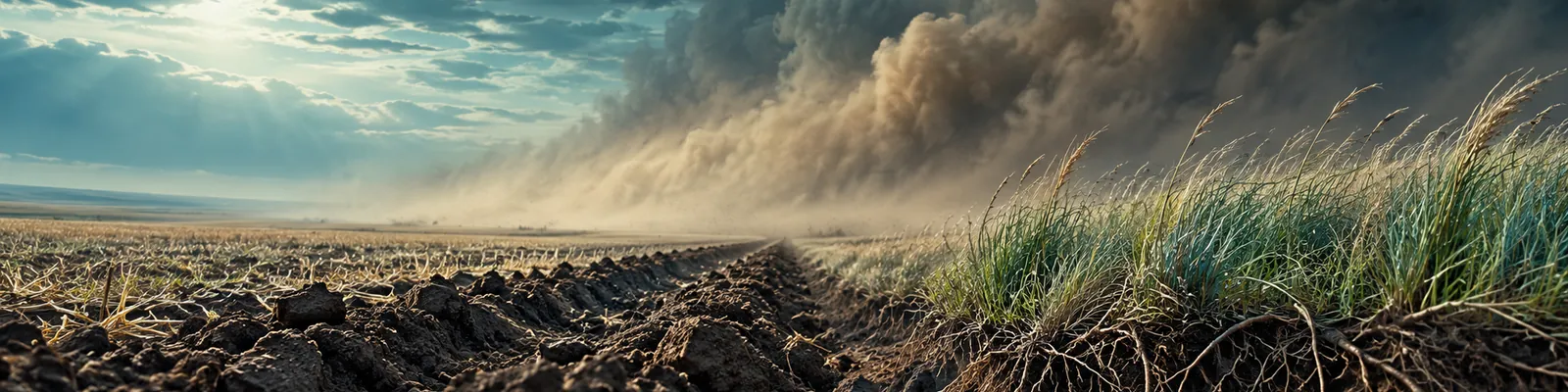
Drought and the plowing of native grassland produced the 1930s dust storms; Congress answered with a permanent Soil Conservation Service in April 1935 and a locally run district system, which cut erosion but paid and governed through landowners, while tenants, sharecroppers and migrants carried much of the loss.
In brief
In the 1930s, drought and the plowing of native grass on the Great Plains put millions of acres of topsoil in the air. A 1935 law created a permanent Soil Conservation Service, and within a few years states passed laws letting farm communities form conservation districts by local vote. That gave some people a say. But in at least one state the vote went to resident landowners, while tenants and sharecroppers, who worked much of the land, lost income or left. Farm payments went out to eroding and non-eroding areas alike, and landlords were told to share with tenants in a rule that was poorly enforced. Researchers find that high-erosion counties lost land value and population that did not come back. The case shows a public program that did some of what it promised, and shows how a program's design decides who votes, who is paid and who pays.
The record
What we could and could not open
We opened: the 1935 statute record at govinfo (Public No. 46, 74th Congress); the NRCS history page; Hornbeck's 2012 paper (Harvard DASH copy); a University of Illinois farmdoc daily series article on lessons of the Dust Bowl; the NPS-hosted FDR conservation documents page; a Living New Deal page on the 1935 Act; the Encyclopedia of Arkansas entry on conservation districts; WETA's Boundary Stones piece on Hugh Bennett; a homesteading-history article on the AAA in the Great Plains; a Bedford/St. Martin's textbook page on the AAA and tenants; a Wikipedia entry on the 1936 Act; a Great Plains Quarterly review (1981) of Worster and Bonnifield; a Farm Progress article.
We could not open: the full text of the Taylor Grazing Act (1934); the 1936 "Future of the Great Plains" report itself (we read FDR-era summaries only); Egan's The Worst Hard Time; Worster's book; Cunfer's On the Great Plains. A search for Cunfer returned only catalog pages, so we do not state his argument.
The disaster
- Plains agriculture expanded from the late 19th century and "native grasslands were increasingly plowed up for crops." Severe drought in the 1930s, especially 1934 and 1936, caused crop failure and left bare soil open to wind (Hornbeck 2012). A farmdoc daily article says more than 100 million acres of native vegetation were plowed under and that homestead acts gave settlers farms "too small to be economically viable" for dry country.
- Black Sunday was April 14, 1935 (WETA). A Farm Progress article says experts estimated 850 million tons of topsoil blew off the Plains in 1935 and that the drought lasted until rain in fall 1941. We treat the topsoil figure as an estimate from a trade-press article, not a measurement.
- About 2.5 million people left the Great Plains by 1940, many for low-paid farm work in California (homesteading-history article; we did not trace this figure to a census table).
- Hornbeck's estimates compare high-erosion counties with low-erosion counties. From 1930 to 1940, relative farmland values fell 30 percent in high-erosion counties; relative population fell 12 percent by 1940; relative agricultural revenue fell 27 percent. The relative land value loss was about $2.4 billion (about $30 billion in 2007 dollars). Long-run adjustment recovered "less than 25 percent" of the initial difference.
The 1935 statute
- Chapter 85, 74th Congress, Public No. 46 (H.R. 7054), approved April 27, 1935. Title: "An Act To provide for the protection of land resources against soil erosion, and for other purposes." The Secretary of Agriculture "shall coordinate and direct all activities" on soil erosion. He may do research, build erosion-control works, acquire land, and enter agreements with "any agency, governmental or otherwise." For non-federal land, he may require states and localities to enact and enforce suitable land-use rules. Section 5 creates the Soil Conservation Service (SCS), built on the earlier erosion organization funded under the National Industrial Recovery Act (govinfo statute record; opened).
- Hugh Hammond Bennett was the SCS's first chief (NRCS history page). He and William Ridgely Chapline had warned of erosion in a 1928 USDA circular (Living New Deal).
The Bennett story, with its caveat
A popular account says a dust cloud reached Washington while Bennett testified, and that it moved Congress. WETA dates the testimony to March 21, 1935, before the House subcommittee, and says Black Sunday came April 14, less than a month later. WETA says the quotations come from Bennett's 1950 biographer Willington Brink, whose telling is dramatic and not a transcript, and that the claim Bennett timed his testimony to a storm is reported but not confirmed. WETA also says Roosevelt signed "the Soil Conservation and Domestic Allotment Act" on April 27, 1935, which is wrong: that April 1935 law is the Soil Conservation Act, and the Domestic Allotment Act is the 1936 law (see below). We did not open the hearing transcript. Treat the "dust arrived during testimony" story as colorful but not established.
Programs after 1935
| Program | What it did | Source |
|---|---|---|
| Soil Conservation Districts | USDA drafted a Standard State Soil Conservation Districts Law. FDR wrote all governors on Feb. 23, 1937. By Apr. 6, 1937 ten states had passed similar laws. Arkansas was first (signed Mar. 3, 1937). 36 states had done so by end of 1939 and all states by 1945. | NPS-hosted FDR documents; farmdoc daily; Encyclopedia of Arkansas |
| Who runs a district | In Arkansas, districts were "created by popular vote of resident landowners." A 1969 amendment limited district voting to landowners. A reader comment on that entry reads the 1969 change as a civil-rights-era backlash; that is opinion, not the entry's text. | Encyclopedia of Arkansas |
| Shelterbelt (tree planting) | Over 32,000 acres planted in two years with emergency funds; about 4,000 farmers cooperating in test plantings; FDR himself said many plantings were too small to affect soil conservation. | NPS-hosted FDR documents (Jan. to Mar. 1937 items) |
| Great Plains Committee | Appointed Sept. 1936, chaired by Morris L. Cooke, Bennett a member. Report "The Future of the Great Plains" sent to Congress Feb. 10, 1937. It noted over fifty federal agencies touched Plains problems and proposed eight federal, nine state and eight local actions. Key line: "Intelligent adjustment to the ways of Nature must take the place of attempts to 'conquer' her." | NPS-hosted FDR documents (a summary; we did not read the report) |
| Land purchase | About 11 million acres bought for $48 million; little was reclaimed cropland. Nearly 60 percent of acres bought in the southern Plains from 1938 to 1941 were rangeland. Moved to the Forest Service in 1953; National Grasslands in 1960. | farmdoc daily |
| Soil Conservation and Domestic Allotment Act, 1936 | Passed Senate 56 to 20 (Feb. 15, 1936) and House 267 to 97 (Feb. 21), signed Feb. 29, 1936, after the Supreme Court struck down the 1933 Agricultural Adjustment Act. Paid farmers to shift from "soil depleting" crops. Landlords were to share payments with tenants and sharecroppers. | Wikipedia; Living New Deal; farmdoc daily |
| Measured effect | An article says research found a 65 to 70 percent reduction in serious wind erosion by 1937, with appropriations "consistently" short. | farmdoc daily (secondary; we did not open the underlying study) |
Who was included, who was left out, who paid
- Landowners voted; tenants are unclear. District formation in Arkansas was by vote of resident landowners. We did not find the voting rules for other states and did not find whether tenant operators could vote anywhere. That is an open question below.
- Payments reached the wrong places as well as the right ones. Historians cited by farmdoc daily say 1936 payments were meant to cut output and move income to farmers and were paid "evenly and undiscriminatingly" across eroding and non-eroding areas.
- AAA money and tenants. By end of 1935 the AAA had paid about $1.1 billion, roughly half to Great Plains farmers. Landowners were to share with tenants, but this was "poorly enforced," some landlords kept the money, and some bought machinery that cut the need for labor. In Oklahoma the number of tenant farmers nearly halved from 1935 to 1945 (homesteading-history article, a secondary source we could not tie to a primary table). A college textbook page says reduced acreage often led landlords to evict tenants, and a Black sharecropper said only $75 a year reached her; that text concerns mostly the cotton South, not the Plains.
- Who paid. Federal taxpayers paid the appropriations, land purchases ($48 million) and AAA benefits. Farmers who adopted terracing, contour farming or new plows bore part of the cost, offset by SCS incentives whose amounts we could not find. Families who left bore losses no program priced.
Timeline
- 1928: Bennett and Chapline USDA circular on erosion (Living New Deal).
- 1933: Soil Erosion Service created under the National Industrial Recovery Act (Living New Deal; govinfo).
- 1934, 1936: Worst drought years (Hornbeck). Taylor Grazing Act, 1934 (named by farmdoc daily as ending free-land homesteading; we did not open the statute).
- Mar. 21, 1935: Bennett testifies on H.R. 7054 (WETA).
- Apr. 14, 1935: Black Sunday (WETA).
- Apr. 27, 1935: Public No. 46 approved; SCS created.
- Feb. 29, 1936: Soil Conservation and Domestic Allotment Act signed.
- Sept. 1936 to Feb. 1937: Great Plains Committee appointed and reports.
- Feb. 23, 1937: FDR asks governors to adopt district laws. Arkansas signs Mar. 3.
- 1938 to 1941: Federal land purchases continue (farmdoc daily).
- 1945: All states have district laws (farmdoc daily).
- 1953 and 1960: Purchased land moves to Forest Service, then National Grasslands.
What this case shows
The Way asks what ordinary people could know, vote on and fix, and what happened when institutions failed them. The Dust Bowl is a case where the failure was slow and shared, and the fix partly gave local people a vote.
- A policy of settlement told people to farm land they were not told was unfit. Farmdoc daily says homesteaders had little knowledge of climate west of the 100th meridian and that railroad promoters and land speculators filled the advice gap. The people who took the risk were the ones who could least check it. The information problem came before the vote.
- The fix put a local vote inside a federal program. The 1935 Act let the Secretary ask states to pass enabling laws. The district model meant a farm county could choose to organize. This is a rare federal program where residents had a ballot over how conservation was run. The cost is the next point.
- The ballot was narrow. In Arkansas, districts were created by resident landowners, and since 1969 only landowners vote. Tenants and sharecroppers worked the land and had no recorded vote in what we found. A program built to protect soil asked the people who owned the soil.
- Those who held the least land lost the most. AAA payments flowed to landowners; tenant counts in Oklahoma nearly halved from 1935 to 1945; many families left. The 1936 Act's rule that landlords share payments is evidence Congress saw the problem, and "poorly enforced" is evidence the rule did not reach everyone.
- Money followed acreage, not erosion. The claim that payments went "evenly and undiscriminatingly" is evidence that a program meant to stop dust also worked as farm income support. Both purposes were public, but the second is why the first was uneven.
- Data came late. Hornbeck notes there were no direct 1930s erosion measurements and uses later cumulative erosion as a proxy. The public record we could read suggests 1935 decisions were made on estimates, not a measured baseline, but we did not read the hearings to check what lawmakers were told.
- Some of the fix was weak and said so. FDR told Wallace the shelterbelt plantings were too small to matter. A government that says so about its own program is giving the public a basis to judge it.
The strongest objections, and our answers
- Objection: It was drought, not farming. Hornbeck's paper says both: drought in 1934 and 1936, plus a century of plowing and "farmer externalities." Worster's thesis, as a 1981 review states it, is that the Dust Bowl came "because the expansionary energy of the United States had finally encountered a volatile, marginal land." We could not verify Cunfer's contrary emphasis, so we do not claim a scholarly split. Mitigation: the essay says "drought and plowing" and does not rank them.
- Objection: The conservation program worked, so the exclusion point is minor. Mitigation: the 65 to 70 percent drop in serious wind erosion by 1937 is reported in one secondary source, and farmdoc daily credits returning rain as the main cause of recovery, with conservation helping before it arrived. Both can be true. The exclusion point concerns who bore costs and who voted, which erosion data do not settle.
- Objection: The tenant evidence is about the cotton South, not the Plains. Mitigation: partly correct. The Oklahoma tenant figure is from the Plains; the sharecropper quotation is from the South and we label it so. Both come from secondary pages and neither is a census table.
- Objection: Landowner-only voting is normal for land districts and not a civil-rights issue. Mitigation: the Arkansas entry says the 1969 amendment narrowed voting. The claim that it was a backlash is a reader's opinion and we do not adopt it. We say only that the vote was limited to owners.
- Objection: Hornbeck's county comparisons show persistence of losses, so the program failed. Mitigation: Hornbeck says himself the $2.4 billion is a relative cost and may overstate or understate the total. He does not evaluate SCS programs. We do not use his numbers to grade the SCS.
- Objection: The Bennett dust-cloud story proves a public shock moved Congress. Mitigation: the story rests on a 1950 biography. We present it as a story and not as a cause.
- Objection: This is a 1930s case with no lesson for now. Mitigation: farmdoc daily notes Ogallala irrigation, which supports nearly 10 percent of U.S. agricultural production, has largely prevented a repeat, but groundwater withdrawals "quintupled from 1949 to 1974." The risk moved; we make no claim beyond that.
Open questions: what would change our minds
- Who could vote in districts. We found Arkansas only. The Standard State Soil Conservation Districts Law and other states' acts should be read to see whether tenant operators could vote or serve. This is unverified outside Arkansas.
- Tenant outcomes on the Plains. We have a single secondary article for the Oklahoma tenant decline. Census of Agriculture tenure tables for 1935, 1940, 1945 would settle it.
- The 65 to 70 percent wind erosion reduction. One secondary article; the SCS or Soil Conservation Service survey behind it was not opened.
- Taylor Grazing Act (1934) and the Great Plains Committee report. We did not read either primary text.
- Cunfer, Egan, Worster. We could not read these and do not state their arguments beyond Worster as quoted in one 1981 review.
- The Bennett hearing. The House subcommittee transcript, March 1935, would show what was said and whether dust was mentioned.
- SCS incentive amounts and cost. Not found.
- Black, Hispanic and Native farmers on the Plains. We did not find Plains-specific sources on their access to SCS services. Do not claim anything here until found.
- If district voting records showed tenants routinely voted, argument 3 would change. If appropriations for SCS were found to be mostly paid to eroding areas, the "undiscriminating" point would change.
Sources
| Title | Publisher | URL | Supports | Opened |
|---|---|---|---|---|
| Soil Conservation Act, Chapter 85, Public No. 46, 49 Stat. (Apr. 27, 1935) | GovInfo, Statutes at Large | https://www.govinfo.gov/link/statute/49/163 | Statute title, Secretary's powers, Sec. 5 SCS (primary) | Yes |
| NRCS history | USDA NRCS | https://www.nrcs.usda.gov/about/history | SCS created Apr. 27, 1935; Bennett first chief | Yes |
| The Enduring Impact of the American Dust Bowl (Hornbeck, AER 2012) | Harvard DASH | https://dash.harvard.edu/server/api/core/bitstreams/7312037c-ec77-6bd4-e053-0100007fdf3b/content | Land value, population, erosion measures, causes | Yes |
| The Conservation Question, Part 3: Lessons in Settling Dust | farmdoc daily, Univ. of Illinois | https://farmdocdaily.illinois.edu/2019/11/the-conservation-question-part-3-lessons-in-settling-dust.html | Causes, districts timeline, land purchases, payments, Ogallala | Yes |
| Franklin D. Roosevelt and Conservation (Part 3) | National Park Service history site | https://npshistory.com/publications/fdr/part3.htm | Great Plains Committee, shelterbelt, 1937 district letters (reproduced primary documents; first 100,000 characters read) | Yes |
| Soil Conservation Act (1935) | Living New Deal | https://livingnewdeal.org/?p=88611 | Dates, Bennett, 1936 amendment aim | Yes |
| Soil and Water Conservation Districts | Encyclopedia of Arkansas | https://encyclopediaofarkansas.net/entries/soil-and-water-conservation-districts-5686/ | Landowner vote, 1969 limit, first state | Yes |
| Hugh Bennett and the Perfect Storm | WETA Boundary Stones | https://boundarystones.weta.org/node/75 | Mar. 21 testimony, Black Sunday, caveats | Yes |
| The Agricultural Adjustment Act in the Great Plains, Part 2 | Homestead on the Range | https://homesteadontherange.com/2017/08/22/the-agricultural-adjustment-act-in-the-great-plains-part-2/ | AAA payments, tenants, out-migration | Yes |
| Casualties in the Countryside (textbook) | Macmillan Learning, The American Promise | https://digfir-published.macmillanusa.com/roark7e/roark7e_ch24_18.html | AAA effects on tenants and sharecroppers (mostly South) | Yes |
| Soil Conservation and Domestic Allotment Act of 1936 | Wikipedia | https://en.wikipedia.org/wiki/Soil_Conservation_and_Domestic_Allotment_Act_of_1936 | 1936 vote counts, landlord sharing rule | Yes |
| Review of Bonnifield and Worster, Great Plains Quarterly 1(1) | Univ. of Nebraska DigitalCommons | https://digitalcommons.unl.edu/greatplainsquarterly/1915 | Worster's thesis as summarized | Yes |
| Dust Bowl forced conservation efforts on U.S. farmers | Farm Progress | https://www.farmprogress.com/farming-equipment/dust-bowl-forced-conservation-efforts-on-u-s-farmers | 850 million tons estimate, drought length (trade press) | Yes |
| Taylor Grazing Act, Worster, Egan, Cunfer | various | not opened | Named leads only | No |
Found an error or a better source? We keep every correction on the record with its date and reason. Nothing here is quietly rewritten.