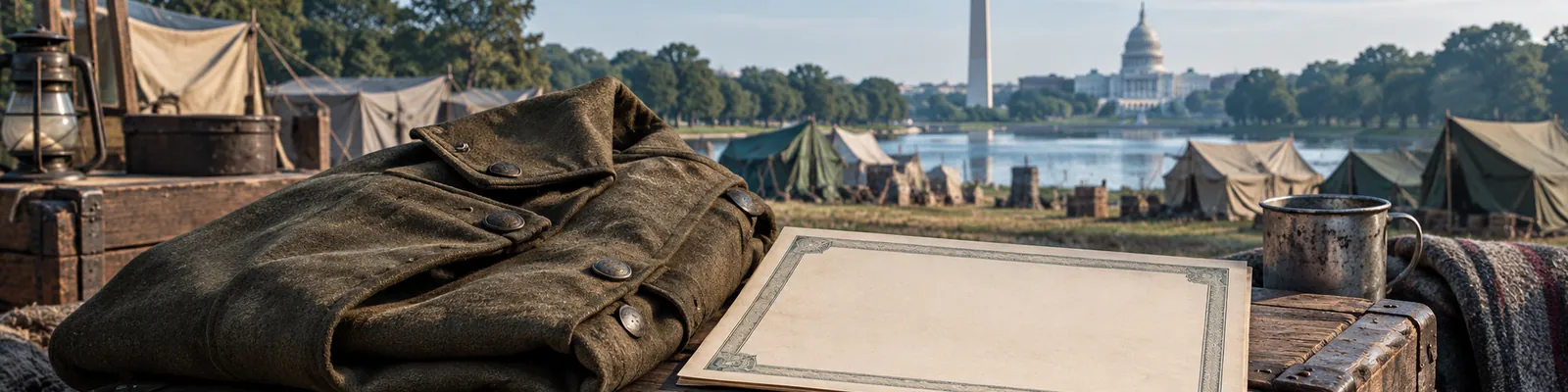
During the Depression, thousands of out-of-work World War I veterans came to Washington to petition Congress for early payment of a bonus already promised for 1945; the Senate said no, police shot two of them, the Army cleared and burned their camps, and four years later Congress paid the bonus over a presidential veto.
In brief
In 1924 Congress promised World War I veterans a bonus, payable in 1945. When the Depression left many of them jobless, thousands came to Washington in 1932 to ask for the money early. They gathered over two million signatures and camped by the thousands, in camps where Black and white veterans lived side by side. On June 15 the House voted yes; two days later the Senate voted no, 62 to 18. After Congress left town, police shot and killed two veterans, William Hushka and Eric Carlson, and President Hoover called in the Army. Troops under General MacArthur used tear gas and tanks, and the camps burned. Officials called the marchers criminals and radicals, though the government's own records showed most were veterans. Opposition to early payment was not partisan: Hoover and Roosevelt both vetoed bonus bills. But in 1936 Congress overrode Roosevelt's veto and paid. The Bonus Army shows that petitioning in person could bring force, while votes, in time, brought results.
The record
The promise (1924 to 1931)
- May 1924: Congress passed H.R. 7959, "To provide adjusted compensation for veterans of the World War." President Coolidge vetoed it on May 15, 1924. The House overrode the veto on May 17 (313 to 78) and the Senate on May 19 (59 to 26). It became Public Law 68-120 (43 Stat. 121). (U.S. Senate, Coolidge vetoes list)
- Terms: Veterans received "adjusted service" certificates payable in 1945 (or to beneficiaries on death), with 4 percent interest building over two decades, calculated at $1 per day of stateside service and $1.25 per day overseas. (U.S. Senate Historical Office, "The Senate and the Bonus Expeditionary Force of 1932") The National Park Service notes it was nicknamed the "Tombstone Bonus." (NPS, The 1932 Bonus Army)
- February 1931: Congress passed H.R. 17054, "To increase the loan basis of adjusted-service certificates." President Hoover vetoed it on February 26, 1931. The House overrode 328 to 79 the same day, and the Senate overrode 76 to 17 on February 27 (Public Law 71-143). (U.S. Senate, Hoover vetoes list) Teaching American History's editors describe this as allowing cash advances of up to half the bonus value. (Teaching American History)
The march and the vote (spring to July 1932)
- Spring 1932: Petitions with more than two million signatures were presented to Congress asking for early payment. (Senate Historical Office)
- May to June 1932: About 400 veterans had gathered in Portland, Oregon, by May 17; about 1,500 men, some with families, were in Washington by June 1. (NPS)
- Camps: Major sites were at 12th and B Streets NW, at 3rd Street and Pennsylvania Avenue NW, and the largest, a 30-acre site on the Anacostia Flats called Camp Bartlett after owner John H. Bartlett, who let the veterans stay there. (NPS) Smithsonian reports the main Anacostia camp held "more than 15,000 people" and that there were 26 smaller outposts. (Smithsonian, Dickson and Allen, 2003)
- Integrated camps: The Senate Historical Office describes the camps as "racially integrated, vibrant communities" that included wives and children. (Senate Historical Office) Smithsonian quotes veteran Jim Banks calling it "the first massive integrated effort that I could remember," and NAACP writer Roy Wilkins: "there was one absentee [in the Bonus Army]: James Crow." (Smithsonian)
- Federal help: The National Archives' Hoover Library blog reports that Hoover quietly had police and the National Guard hand out Army rations, tents, cots, and medical supplies, and that he thought most marchers were honest veterans who could assemble "as long as they did so peacefully." (Hoover Presidential Library blog, National Archives)
- June 15, 1932: The House passed the bonus bill (the Patman bill for immediate payment) 211 to 176. (Smithsonian; Bill of Rights Institute) The Senate Historical Office says only that the House "narrowly approved" it. Hoover had promised to veto it. (NPS)
- June 17, 1932: After about ten hours of debate, with thousands of veterans on the Capitol's East Front Plaza, the Senate defeated the bill 62 to 18 shortly after 9 p.m. The Finance Committee had recommended that it "not pass." Sen. Elmer Thomas: "Billions for big business, but not a sou for soldiers!" Sen. Joseph T. Robinson: "I do not favor cash payments of adjusted service certificates." (Senate Historical Office)
- July 16 and 20, 1932: Congress adjourned on July 16. On July 20 city officials issued an eviction notice to the marchers' leaders. (Senate Historical Office) The Veterans' Bureau issued transportation home to 4,344 veterans by rail and 939 by automobile, per the Attorney General's later report. (American Presidency Project, Sept. 1932) Loans for fare were "interest-free loans charged against their bonus certificates." (Hoover Library blog)
July 28, 1932
- Police shootings: During an eviction attempt at an abandoned building downtown, police opened fire. William Hushka, a Lithuanian immigrant and World War I Army veteran, was killed. Eric Carlson, a veteran born in 1894, was shot and died within a week (date listed as August 2, 1932). Both were buried at Arlington National Cemetery. (Histories of the National Mall, George Mason University: Hushka; Carlson; Hoover Library blog) NPS spells the name "William Hashka" and names him as killed "by police fire near the US Capitol." (NPS) Smithsonian reports three policemen were injured. (Smithsonian)
- Hoover's order: The same day Hoover said, "I have asked the Army to assist the District authorities to restore order," citing the District Commissioners' statement that "they can no longer preserve law and order in the District," and asserting that "many are communists and persons with criminal records." (American Presidency Project, July 28, 1932) Secretary of War Patrick Hurley told Gen. Douglas MacArthur to "Surround the affected area and clear it without delay" and to "Use all humanity consistent with the due execution of this order." (Hoover Library blog)
- The troops: MacArthur led about 800 troops, with about 2,700 in reserve; troops used tear gas and bayonets; five tanks operated at the 3rd and Pennsylvania camp. (NPS) Maj. George S. Patton commanded saber-armed cavalry. (Bill of Rights Institute) Patton also routed Joe Angelo, who had saved his life in World War I. (NPS) Maj. Dwight D. Eisenhower, MacArthur's principal aide, urged him to stay off the streets but was ordered to accompany him. (Smithsonian)
- Crossing into Anacostia and the fires: Eisenhower later said Hurley, relaying the president's wishes, had forbidden troops to cross the bridge into Anacostia, and that MacArthur said he was too busy to be bothered; Eisenhower later recalled, "I told that dumb son-of-a-bitch he had no business going down there." (Smithsonian; also Bill of Rights Institute) Troops set fire to the shanty towns with torches, per NPS. (NPS) MacArthur claimed he "had specifically prohibited burning the camps" and blamed retreating marchers; the camps were in flames after troops arrived shortly after 9 p.m., and the rest were demolished the next day. (Hoover Library blog)
Official accounts (1932)
- July 29, 1932: Hoover: "A challenge to the authority of the United States Government has been met, swiftly and firmly," and "Government cannot be coerced by mob rule." A judge's grand jury charge released by the White House described the crowd as largely "communists, and other disorderly elements." (Teaching American History)
- MacArthur said the movement "was animated by the essence of revolution" and claimed only about 10 percent of those driven out were genuine veterans. (NPS)
- September 1932 Attorney General's report: Of 3,656 registered marchers checked, "877, or a little more than one-fourth, could not be identified" as World War veterans; of 4,723 fingerprinted ex-servicemen who obtained loans, 1,069 had police records and 829 had convictions. It reported two marchers killed, both by police, and none by troops. It also said Veterans Administrator Frank Hines believed no more than 8,000 veterans were present at any one time. Hoover said the report showed "the extraordinary proportion of criminal, Communist, and nonveteran elements." (American Presidency Project)
- Note: by the government's own figures, roughly three-quarters of registered marchers checked were identified as veterans, which conflicts with MacArthur's 10 percent claim.
After 1932
- November 1932: Roosevelt defeated Hoover, and 14 Senate incumbents lost. (Senate Historical Office)
- 1933: Marchers returned. By May about 3,000 were in a tent camp the new administration had the Army set up; Eleanor Roosevelt visited. About 2,600 accepted work in the Civilian Conservation Corps. (Smithsonian)
- May 22, 1935: Roosevelt vetoed H.R. 3896 (immediate payment), calling it "a new straight gratuity or bounty to the amount of $2,600,000,000." (American Presidency Project) The House overrode 322 to 98; the Senate sustained the veto on May 23 (54 to 40, short of two-thirds). (U.S. Senate, F. Roosevelt vetoes list)
- September 2, 1935: The Labor Day hurricane struck the Florida Keys. The National Archives reports over 600 veterans were in federal relief work camps there and 262 of them died; three veterans' camps were destroyed. Roosevelt asked the Veterans Administration and the Federal Emergency Relief Administration to investigate; investigators disagreed about negligence. (National Archives, Text Message blog) NOAA estimates about 600 total deaths. (NOAA AOML) Smithsonian calls the Keys workers "jobless remnants of the Bonus Army" and gives "at least 256" veterans killed. (Smithsonian)
- January 1936: Roosevelt vetoed H.R. 9870 on January 24, 1936: "My convictions are as impelling today as they were then." (American Presidency Project) The House overrode 326 to 61 the same day; the Senate overrode 76 to 19 on January 27. It became Public Law 74-425 (49 Stat. 1099). (U.S. Senate, F. Roosevelt vetoes list)
- June 1936: Veterans began cashing payments averaging about $580; nearly $2 billion went to about 3 million veterans. (Smithsonian)
Disputed numbers: size of the Bonus Army
| Estimate | Who says it | Source checked |
|---|---|---|
| "from five to ten thousand" | 1932 grand jury charge released by the White House | Teaching American History |
| 8,000 to 15,000 at adjournment; 6,000 to 8,000 at the riot; no more than 8,000 veterans at once (Hines) | Attorney General's report, Sept. 1932 | American Presidency Project |
| "more than 11,600 veterans" in the camps | Senate Historical Office | senate.gov |
| "somewhere between 10,000 and 20,000" | National Park Service | NPS |
| "roughly 17,000 people" | Teaching American History editors | Teaching American History |
| about 20,000 or more | Dickson and Allen | Smithsonian |
| 8,000 to 25,000 men; up to 60,000 with families | Hoover Library blog (National Archives) | hoover.blogs.archives.gov |
| more than 25,000 veterans and families | Bill of Rights Institute | BRI |
The safest statement: somewhere between about 10,000 and 20,000 people at the peak, with official 1932 counts lower and some later counts higher. Numbers changed over the summer, so different counts may describe different dates.
What this case shows
- This was the right to petition used by people who had little besides their votes and their bodies. The First Amendment protects "the right of the people peaceably to assemble, and to petition the government for a redress of grievances." (Cornell LII) Out-of-work veterans could not hire lobbyists; they gathered more than two million signatures and then came in person. (Senate Historical Office)
- Petitioning in person was met with force. After the Senate vote and adjournment, police shooting killed two veterans and the federal government used troops, tanks, tear gas, and fire to clear the camps, including the Anacostia camp on private land. (NPS; Hoover Library blog; mallhistory.org)
- Official accounts recast poor petitioners as criminals and radicals. The President and the Army chief described the marchers as Communists, criminals, and mostly non-veterans. The government's own September 1932 data identified about three-quarters of registered marchers checked as veterans, which does not support MacArthur's 10 percent claim. (American Presidency Project, July 28; Sept. 1932 report; NPS)
- Votes mattered in the end. Fourteen Senate incumbents lost in 1932, and in 1936 Congress overrode a presidential veto 326 to 61 and 76 to 19 to pay the bonus. Veterans as a voting bloc won through elections what they could not win by camping in Washington. (Senate Historical Office; Senate vetoes list)
- Black and white veterans camped together in a segregated capital and era. The Senate Historical Office calls the camps "racially integrated," and Roy Wilkins wrote that "James Crow" was absent. This contrasted with the segregated Army these men had served in and with the Jim Crow laws of the time. (Senate Historical Office; Smithsonian)
The strongest objections, and our answers
- Objection: This was not about voting rights; the veterans could vote. Mitigation: Correct. The tie is indirect. Most marchers were not barred from voting. The case is about political voice and petition, and it actually shows the vote working, eventually, for a large organized group. It fits as a contrast: people with money get heard through lobbying, while poor people who petitioned in person were treated as a threat. We should not claim the marchers were disfranchised. (Black veterans from Jim Crow states may have faced barriers at home, but we found no source on the Bonus Army members specifically.)
- Objection: Both parties' presidents opposed early payment, so this is not a story of one villain. Mitigation: Agreed, and we say so. Coolidge vetoed the 1924 bonus, Hoover vetoed the 1931 loan increase and promised to veto the 1932 bill, and Roosevelt vetoed payment in 1935 and 1936. The 1932 Senate vote (62 to 18 against) was lopsided. The overrides were bipartisan. (Senate vetoes lists)
- Objection: The government had a fair fiscal case; the certificates were not due until 1945. Mitigation: True. Roosevelt called immediate payment "a new straight gratuity or bounty" of $2.6 billion, and the Depression strained the budget. The case does not show the bonus was owed early; it shows how the petitioners were treated. (American Presidency Project)
- Objection: There was rioting on July 28, and police were injured. Mitigation: Yes, there was a clash at the downtown building and three policemen were injured. The District commissioners asked for help. But the troops went on to clear and burn the Anacostia camp, on private land, where Eisenhower said Hurley had forbidden them to cross. (Smithsonian; NPS)
- Objection: The Attorney General found many non-veterans and many with records. Mitigation: The report's own figures still show most marchers checked were veterans, and it conceded some unidentified men may have had incomplete records. A criminal record does not remove the right to petition. (American Presidency Project)
- Objection: Hoover was not hostile; he supplied rations and tents and paid fares home. Mitigation: Fair, and we include it. The Hoover Library reports the quiet aid, and Hurley's order said "Use all humanity." Who decided to cross into Anacostia and burn the camps is disputed: MacArthur denied ordering the burning, and Eisenhower said MacArthur ignored instructions. (Hoover Library blog; Smithsonian)
- Objection: The size of the march and the integration claim may be inflated. Mitigation: We give the range and sources. On integration, the Senate Historical Office states it directly, and Smithsonian cites participants. We have no count of Black marchers.
- Objection: The 1935 hurricane is not part of the Bonus Army story. Mitigation: The link is through the federal work camps for jobless veterans. The National Archives post does not mention the Bonus Army; Smithsonian makes the link. Use it as a footnote, not a core claim.
Open questions: what would change our minds
- The House roll call of June 15, 1932: two secondary sources give 211 to 176, but we could not load the House History page (blocked to our fetcher) or the Congressional Record to confirm it.
- Size of the march: no single count; a primary police or Veterans Administration registration total would help.
- Number and share of Black veterans in the camps: we found no count.
- Who ordered the camps burned: MacArthur's denial versus NPS's statement that troops used torches. Army after-action reports at the National Archives could settle this.
- Other deaths sometimes attributed to the eviction (for example, an infant said to have died after tear gas) are reported in some accounts; we did not verify them and do not include them.
- Hurricane veteran deaths: 262 (National Archives) versus "at least 256" (Smithsonian). An official VA or congressional figure would settle this.
- If evidence showed the marchers were mostly not veterans, argument 3 would weaken, though not argument 1.
Sources
| Title | Publisher | Supports |
|---|---|---|
| The 1932 Bonus Army | National Park Service | 1945 date, camps, size range, troops, tanks, burning, Hashka/Hushka, Patton and Angelo, MacArthur quotes, 1936 override |
| The Senate and the Bonus Expeditionary Force of 1932 | U.S. Senate Historical Office | 1924 terms, petitions, 11,600 veterans, integrated camps, Senate vote 62 to 18, adjournment and eviction dates, 1932 election |
| Vetoes by President Coolidge | U.S. Senate | 1924 veto and override |
| Vetoes by President Hoover | U.S. Senate | 1931 veto and override |
| Vetoes by President F. Roosevelt | U.S. Senate | 1935 veto sustained; 1936 veto overridden, vote tallies, Public Law 74-425 |
| Veto of the Bonus Bill (May 22, 1935) | American Presidency Project, UC Santa Barbara | Roosevelt's reasons, $2.6 billion |
| Veto of the Soldiers' Bonus (Jan. 24, 1936) | American Presidency Project | 1936 veto |
| Statement About the Bonus Marchers (July 28, 1932) | American Presidency Project | Hoover's order and stated reasons |
| Statement on the Justice Department Investigation of the Bonus Army (Sept. 1932) | American Presidency Project | Official figures on veterans, records, deaths, transport home |
| Statement on the Dispersal of the Bonus Army (July 29, 1932) | Teaching American History | Hoover quotes, grand jury estimate, 1931 advance |
| Bonus Army | Hoover Presidential Library blog, National Archives | Federal aid, Hurley's order, MacArthur's denial on burning, size range |
| William Hushka; Eric Carlson | Histories of the National Mall, RRCHNM, George Mason University | https://mallhistory.org/items/show/407 ; https://www.mallhistory.org/items/show/434 |
| Marching on History (Dickson and Allen, Feb. 2003) | Smithsonian magazine | House vote 211 to 176, integration quotes, Eisenhower, 1933 march, Keys camps, 1936 payments |
| The Bonus Army | Bill of Rights Institute | House vote 211 to 176, Patton's cavalry, Eisenhower's objection |
| The Labor Day Hurricane of 1935 | National Archives, Text Message blog | 600+ veterans in camps, 262 died, investigations |
| 80th Anniversary of the Labor Day Hurricane | NOAA AOML | Date, intensity, about 600 total deaths |
| First Amendment | Cornell Legal Information Institute | Petition clause text |
Found an error or a better source? We keep every correction on the record with its date and reason. Nothing here is quietly rewritten.