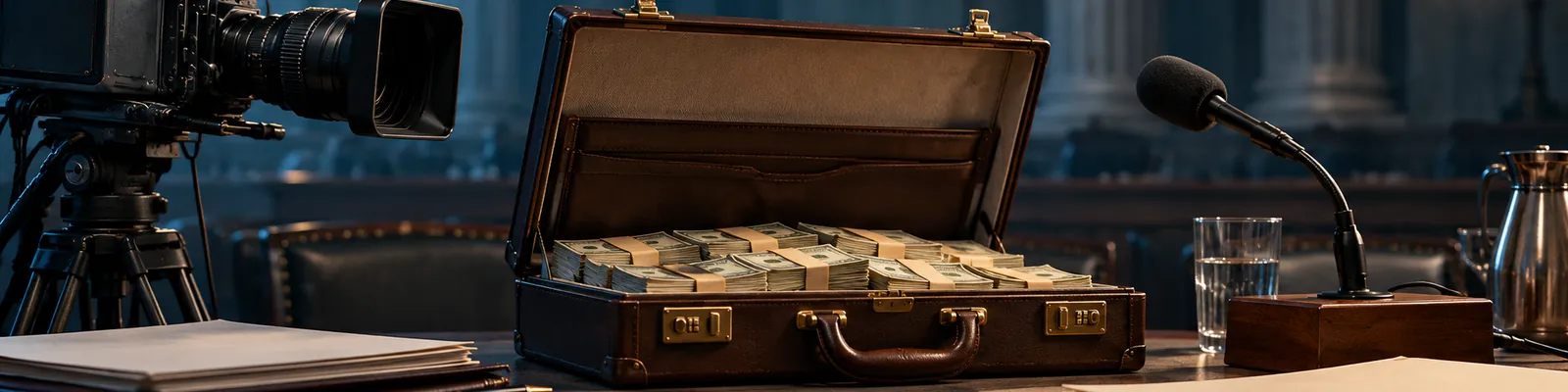
In a two-year FBI sting, agents posing as agents of a rich Arab sheik offered cash and favors to public officials and videotaped what happened; the tapes led to the conviction of one senator and six House members, the first House expulsion since the Civil War era, and the first written Justice Department rules for undercover work.
In brief
In 1978 the FBI built a fake company owned by an invented Arab sheik and used it to offer money to public officials, with hidden cameras running. Over the next year, at least twelve members of Congress were offered cash. Seven took it: a senator and six House members, six of them Democrats and one a Republican. At least five did not. No one has published a full list of everyone who was approached, so no exact percentage exists, and the story reached voters through leaks, trials and tapes rather than any systematic disclosure. The sting ended on February 2, 1980, because NBC reported it, not because anyone chose to stop. The Justice Department's first written rules for undercover work came a year later. Courts rejected entrapment claims on appeal, but a Senate committee found the FBI had run it without guidelines and had put innocent officials before the cameras. For voters the lesson is mixed: the tapes showed what no disclosure form could, and the process still left them with partial and uneven information.
The record
The two questions Frank asked
Question 1: What percentage of the officials approached took the money?
Short answer: no one has published a full list of everyone who was approached, so no exact percentage exists. For members of Congress, the best documented count is 12 offered, 7 took it, 5 did not: 7 of 12, about 58 percent. That is a floor on the number approached, not a total.
The arithmetic, with the source for each line:
| Group | Count | Source |
|---|---|---|
| Members of Congress convicted (took the money) | 7: Sen. Harrison Williams (D-NJ); Reps. Frank Thompson (D-NJ), John Jenrette (D-SC), Raymond Lederer (D-PA), Michael "Ozzie" Myers (D-PA), John Murphy (D-NY), Richard Kelly (R-FL) | Senate Select Committee report, S. Rept. 97-682, p. 2 ("a United States Senator, six Members of the" House); Senate expulsion page |
| Members of Congress offered money who did not accept | 5: Sen. Larry Pressler (R-SD), Reps. Edward Patten (D-NJ), John Murtha (D-PA), Raphael Musto (D-PA), James Mattox (D-TX) | FBI Legal Counsel Division memo on "ABSCAM," about Feb. to Mar. 1982, in the FBI Vault Murtha file: "six Congressmen were contacted by intermediaries and were proffered money"; "None of the six accepted" |
| A sixth name on that memo | Rep. Peter Rodino (D-NJ). The memo says he "was never personally contacted by FBI representatives" and that offers were made for his help to others. We do not count him as approached. | Same memo |
| Documented total offered | 12 | 7 + 5 |
| Took it | 7 of 12 = 58.3 percent | Our math |
| Did not take it | 5 of 12 = 41.7 percent | Our math |
How each of the five who did not accept responded (same FBI memo): Pressler "flatly declined" and is described as the only one who did; Patten "made no response to the offer and never directly indicated that he perceived that a bribe offer was being made"; Murtha was contacted on several occasions, said he would get back in touch, and never recontacted the offeror; Musto "was offered a bribe on one occasion and did not accept"; Mattox "did not accept the offer" but later testified that he knew he had been offered a bribe. So only one of the five clearly refused on the spot. A Boston College Law Review note says "all but three" of the officials who met agents on tape accepted, and names the three who declined as Pressler, Patten and Murtha (Notes, "The Abscam Investigation," 25 B.C. L. Rev. 351, 352 n.14, citing the Myers trial court opinion, 527 F. Supp. 1206, 1225).
Other counts you will see, and what each actually counts:
- "31 officials": the figure given by two secondary sources (Wikipedia; EBSCO Research Starters) for the politicians named by the Camden mayor, Angelo Errichetti, and arranged for meetings. This is the number of names offered by a middleman, not a count of people who were shown money. We could not find it in a primary source.
- "Almost a dozen elected officials" met agents at monitored locations by the end of 1979 (B.C. L. Rev. note, p. 352).
- "Twenty-six defendants" were indicted within a year in three jurisdictions (B.C. L. Rev. note, p. 352); the Pace Law Review article says 25 individuals (p. 1575). The count differs by source and by whether co-defendants are included.
- All non-congressional officials who were convicted: Errichetti (Camden mayor, a Democrat), Philadelphia City Council members George Schwartz, Harry Jannotti and Louis Johanson, and an INS inspector. The Senate committee summary (p. 2) lists "the Mayor of Camden, New Jersey, three members of the City Council" among those convicted.
What was disclosed and what was not:
- Disclosed: the convictions; the tapes shown at trial; the Senate Select Committee's December 1982 report (S. Rept. 97-682, 790 pages, which includes a chronology in Appendix A and a "summary of prosecutions" in Appendix G); the FBI Legal Counsel memo (released later through the FBI Vault).
- Not published, as far as we could find: a complete list of every public official who was contacted, shown money, or named by a middleman, with each outcome. The Senate report itself says "at least one (and apparently more) clearly innocent public official was brought before the hidden cameras" (p. 19) because of the FBI's "unduly unquestioning reliance on middlemen," and that "none of the individuals who attended videotaped meetings with FBI undercover operatives had been targeted by the FBI" before a middleman raised the name (p. 13). It does not publish those officials' names. The report also notes (p. 13, n. 2) problems with "the targeting of public officials who never attended any meeting" with undercover operatives.
- Not checked: we could read only roughly the first 113,000 characters (through about page 23) of the 790-page report, so Chapter Six (the Abscam narrative, pp. 56 to 323) and Appendices A and G were not reviewed. They may contain a fuller count.
Party breakdown, and the "mostly Democrats" question
Party of the members of Congress in the documented groups, and of the Congress they sat in:
| Group | Democrats and Republicans | Share Democratic |
|---|---|---|
| Convicted (7) | 6 D, 1 R (Kelly) | 86 percent |
| Documented offered, taken or not (12) | 10 D, 2 R (Kelly, Pressler) | 83 percent |
| House at start of the 96th Congress (Jan. 1979) | 276 D, 156 R (plus 1 Conservative, 2 vacant) | about 64 percent of 433 seated |
| Senate at start of the 96th Congress | 58 D, 41 R (plus 1 independent) | 58 percent |
| Both chambers combined | 334 D, 197 R | about 63 percent of the 531 who were D or R |
The seat counts are from the Wikipedia "96th United States Congress" party-division table. The same page's summary box gives different Senate numbers (57 D, 42 R), and we did not confirm either against the House Clerk or the Senate Historical Office, so treat the exact seat counts as approximate. The party of Patten, Murtha, Musto, Mattox, Pressler and the others is from the standard biographical directories as we remember them, except for Musto, which we confirmed (Wikipedia: Democrat, PA-11, in the U.S. House Apr. 9, 1980 to Jan. 3, 1981); we did not re-fetch the others in this pass.
Our math on whether this is just chance: if 7 convicted members were drawn at random from a Congress that was about 63 percent Democratic, the chance of getting 6 or more Democrats is about 20 percent (7 x 0.63^6 x 0.37 + 0.63^7 = 0.162 + 0.039). For the 12 documented offered, the chance of 10 or more Democrats is about 12 percent. Neither is below the usual 5 percent bar, and with numbers this small and a non-random selection process it proves nothing in either direction. What the numbers do say: yes, most of those convicted were Democrats (6 of 7), which matches the usual summaries, and the sample is also close to the share of Democrats in Congress. The selection was not random. The middlemen who brought officials to the tapes were themselves Democratic officeholders or associates (Errichetti, a Democrat, and the Philadelphia lawyer Howard Criden), and recruited from networks in Camden, Philadelphia and New Jersey Democratic politics (Pace L. Rev., p. 1572, on Errichetti and Criden's roles; Myers, 692 F.2d 823, on how Thompson, Murphy, Myers and Lederer were brought in). The Senate committee found the FBI did not "abandon or fail to follow any investigative lead for any improper purpose" (p. 13) and that "there is no evidence that these leaks were politically motivated" (p. 14), but it also did not decide whether the targeting was fair to everyone.
Question 2: Why was it stopped?
Short answer: the secret stage ended because it became public. The documented chain is a media leak on February 2, 1980, not a decision by Congress or the courts. Reforms followed afterward. The deeper question of whether the FBI would have continued, and whether more members would have been caught, is asserted but not documented.
Documented:
- Date: The Senate committee says "the covert stage had ended on February 2, 1980" (p. 21). The Boston College note says the investigation "was terminated" that day "as information... began to leak to the press" (p. 352, citing 527 F. Supp. at 1211). NBC News broke the story that Saturday evening, and The New York Times and other outlets reported it the next day (EBSCO Research Starters).
- The leak: The committee found "massive leaks of confidential information that could have come only from persons" inside the FBI or Justice Department (p. 22), that the leaks "did not result from any reasonably curable deficiency" in FBI or Justice Department policy (p. 14), and that "that investigation [of the leaks] did not result in the identification of anyone responsible for the most serious leaks" (p. 22). It also found that "there is no evidence that these leaks were politically motivated" (p. 14). The leaks "compounded" harm to "unquestionably innocent individuals" (p. 22). Senator Pressler is the example the committee itself cites, in recommending that the Justice Department confirm in writing, on request, that a leaked-about person is not a suspect (S. Hrg. 98-1289, p. 37).
- Justice Department: The committee judged the department's conduct at the end "in part commendable and in part unjustifiable" (p. 21). It said the department officials Heymann and Nathan acted commendably in giving defense counsel several tapes, but their decision to publish a prefatory portion of the Nathan memorandum was "unjustifiable" (pp. 21 to 22).
- Guidelines: Attorney General Benjamin Civiletti announced the first Justice Department guidelines on FBI undercover operations on January 5, 1981, scheduled to take effect about two weeks later, according to the DOJ press release and text preserved by NCJRS. The Boston College note says they were issued December 31, 1980 (p. 377 n.326); the date on the text itself is blank. They state "Entrapment should be scrupulously avoided" (para. J(1)), require that "the corrupt nature of the activity is reasonably clear to potential subjects" (J(2)(a)), allow an operation where there is "a reasonable indication" that the subject is engaged in or likely to engage in similar illegal activity, or where the opportunity is structured so that those drawn to it are predisposed (J(3)(a) and (b)), and send "sensitive circumstances" such as public corruption to the Director or an Assistant Director (paras. B and D). The department said the standards are "significantly more restrictive than those required by the law of entrapment." The Senate committee itself found "the absence during the Abscam investigation of Department of Justice guidelines governing undercover operations" (p. 12). So the guidelines came after the sting and did not end it.
- Senate Select Committee: created by Senate Resolution 350 on March 25, 1982, after the debate on expelling Sen. Williams; first met March 31; report submitted December 15, 1982 (pp. 5 to 6). Its main findings: undercover work has "substantially contributed" to law enforcement and Abscam produced convictions "likely to deter public officials in the future from readily selling their offices for private gain" (pp. 11 to 12); nine juries convicted every defendant who appeared before them (p. 12); no appellate court to date had found a violation of defendants' constitutional rights (p. 12); "none of the Abscam defendants was merely playacting" and each who received money "understood that the payment was a bribe" (p. 14); but the FBI lacked guidelines, managed informant Melvin Weinberg and the tapes poorly (pp. 17 to 18), and relied on middlemen in a way that put "at least one (and apparently more) clearly innocent public official" before the cameras (p. 19). It expressly did not decide guilt, entrapment or due process (p. 13). It found "no such encroachment occurred in Abscam" on the legislative branch (S. Hrg. 98-1289, pp. 37 to 38). It recommended a limited objective entrapment defense (B.C. note and Pace article) that Congress did not enact in the form proposed (the bill, S. 804, was still in hearings in May 1984).
- Entrapment rulings (courts applied the "predisposition" test, asking whether the defendant was "ready and willing"):
- Jannotti and Schwartz (Philadelphia councilmen): Judge John Fullam set aside the verdicts in 1980, finding no predisposition and writing that it is "not within the legitimate province of federal agents to embark upon a program of corrupting municipal officials." The Third Circuit, en banc, reinstated the verdicts (United States v. Jannotti, 673 F.2d 578 (3d Cir. 1982); cert. denied).
- Myers, Lederer, Thompson, Murphy: Judge George Pratt held a 16-day due process hearing and rejected the claims (527 F. Supp. 1206). The Second Circuit affirmed (United States v. Myers, 692 F.2d 823 (2d Cir. 1982)), reversing only Murphy's Count Three for a new trial. Only Lederer raised entrapment at trial; the videotape showed him say "I'm not a Boy Scout." Myers claimed he was "playacting"; the court held that is not a defense to bribery.
- Williams: Convicted May 1, 1981 on all nine counts. The Second Circuit affirmed (United States v. Williams, 705 F.2d 603 (2d Cir. 1983)): sufficient evidence of predisposition; the Supreme Court "has never applied the Due Process Clause to invalidate a conviction based on 'outrageous' governmental inducement." The court noted that Weinberg had "coached" the senator before one meeting and held that did not amount to outrageous conduct.
- Kelly: Judge Bryant set aside the conviction, saying the government acted without "remotest suspicion" and that the testing "should have ended" after Kelly rejected the bribe (539 F. Supp. 363, as quoted in the Pace article). The D.C. Circuit reinstated it (United States v. Kelly, 707 F.2d 1460 (D.C. Cir. 1983)), writing that outrageousness would require "coercion, violence or brutality to the person" (707 F.2d at 1476, as quoted in the B.C. note). We did not read the Kelly opinion itself.
- Jenrette: affirmed (United States v. Jenrette, 744 F.2d 817 (D.C. Cir. 1984)): he "readily responded to the opportunity"; due process bars conviction only in the "rare instance" of police overinvolvement at "a demonstrable level of outrageousness." He had said, "I got larceny in my blood."
- Boston College note: the cases show a split between trial judges who saw excess and appeals courts that did not; the Supreme Court denied review in Jannotti.
Asserted, not documented:
- That the operation was cut short and "might have nabbed a great deal more Congressmen" had the press not scooped it (a blog summary of Weinberg and FBI claims; Global Anticorruption Blog, 2021). We found no primary document stating the FBI planned to continue or how many more were scheduled.
- That the congressional response (hearings, the Select Committee, the House Civil and Constitutional Rights subcommittee hearings from March 1980, report April 1984) was a motive to rein in the FBI. The Senate committee says it found no encroachment on the legislature, and we have no evidence of motive either way.
- That the operation lost money or time to run out. Secondary sources cite a $1 million fund (Wikipedia; Encyclopedia of Greater Philadelphia); we found no primary figure for what remained.
Timeline
- Mar. 1978: Abscam begins on Long Island under FBI agent John Good as a stolen-property sting; the only application to FBI headquarters, filed May 26, 1978, "contained no description of the informant" (Senate report, p. 15). Informant Melvin Weinberg, a convicted swindler, runs the "Abdul Enterprises" front, backed by a $1 million FBI account (Wikipedia; Senate report on Weinberg).
- Sept. to Oct. 1978: Focus shifts from property crime to political corruption; "no application for approval of the shift" was filed (Senate report, p. 16).
- Feb. 12, 1979: Videotaping begins (p. 19).
- Aug. 22, 1979: "No Member of the House of Representatives was offered a bribe until August 22, 1979" (p. 19). Myers takes $50,000 in cash that day at a hotel (Myers, 692 F.2d 823).
- Late 1979 to Jan. 1980: Other members meet agents (we did not establish the date of Pressler's meeting). Jenrette: told "fifty thousand dollars now and fifty thousand dollars when this thing is introduced," he has an intermediary collect $50,000 on Dec. 6, 1979 (Jenrette opinion). Pressler declines a campaign-contribution offer and leaves. Williams meets agents at least seven times over about a year (Pace; B.C.).
- Feb. 2, 1980: NBC reports the sting; the covert stage ends. Within days, names of subjects are in the press, including some who had done nothing wrong.
- Spring 1980: House Civil and Constitutional Rights subcommittee begins hearings (March); Murtha is not charged; the department announces in November 1980 that he will not face charges (Wikipedia).
- 1980 (before Oct. 2): Myers convicted of taking $50,000 (we did not establish the trial date). Oct. 2, 1980: the House expels Myers 376 to 30 (Christian Science Monitor). EBSCO calls it the first House expulsion since 1861 and the only one for a cause other than treason. Myers told the House, "I owe this House an apology," and claimed entrapment.
- Oct. 30, 1980: Williams indicted on nine counts (Senate page).
- Late 1980: Jenrette resigns before an expulsion vote; Thompson resigns Dec. 29, 1980 (Wikipedia, EBSCO). Lederer and Murphy lose or leave in ways that differ by source (see below).
- Jan. 5, 1981: Civiletti announces the undercover guidelines.
- May 1, 1981: A jury convicts Williams on all counts. Aug. 24, 1981: the Senate Ethics Committee unanimously finds his conduct "ethically repugnant" and recommends expulsion; Sept. 3, 1981: resolution reported (Senate page).
- Feb. 17, 1982: Williams sentenced to three years and a $50,000 fine. Mar. 3 to 11, 1982: Senate debate on expulsion; Mar. 11, 1982: Williams resigns before the vote (Senate page). He served 21 months and was released Jan. 31, 1986.
- Mar. 25, 1982: Senate creates the Select Committee. Dec. 15, 1982: report submitted.
- 1982 to 1984: Appeals courts affirm or reinstate the convictions; Jenrette's affirmed 1984. The Senate Subcommittee on Criminal Law hears S. 804 (the Undercover Operations Act) May 16, 1984.
What this case shows
The question: voters face barriers to knowing and judging their representatives. Abscam is a case where the barrier was visible and then briefly lifted, and the way it was lifted raises its own questions.
- Video evidence showed voters what no disclosure rule would have. Campaign finance reports and financial disclosures list what officials report. They do not show a member of Congress accepting an envelope of cash and saying he can introduce a private bill. The tapes shown at trial gave voters and colleagues the unusual ability to judge officials by their own words, such as Myers: "Absolutely. Where I could be of help in this type of a matter, first of all, is private bills that can be introduced" (692 F.2d 823), and Jenrette: "I got larceny in my blood" (744 F.2d 817). Without a sting, voters have no tool for this.
- Even the tapes reached voters unevenly. Most of what the public knew in February 1980 came from leaks, not from any official disclosure. The Senate committee found the leaks hurt "unquestionably innocent individuals" and that no one was identified or punished for them (pp. 14, 22). Pressler, who refused and reported the approach, was among those whose names circulated in the press. A voter in that month could not tell who took money and who did not, which is the opposite of what a well-informed electorate needs.
- Nobody published the full denominator. We can state that 7 members took the money and at least 5 did not (about 58 percent). We cannot state how many were approached overall, because the FBI and Justice Department never released a complete list, and the committee did not name the innocent officials who were brought before the cameras. A voter cannot judge whether an official who was approached and said no did the right thing, because the "no" often is not on the public record.
- When voters did learn, they did not always act as accountability theory predicts. Secondary sources say Lederer was reelected in November 1980 after the sting was public, while Kelly lost his primary and Thompson and Murphy lost at the polls (EBSCO Research Starters). Myers kept campaigning after he was expelled. We have not verified these results against election returns. If true, voters with the same information reached different judgments, which cuts against both "voters need only more information" and "voters cannot be trusted."
- Institutions policed themselves unevenly. The House expelled Myers 376 to 30 and the Senate was about to expel Williams. In Murtha's case the House Ethics Committee declined to file charges in a mostly party-line vote in July 1981 (Wikipedia; one source describes the special counsel's resignation the same day as a protest). Those facts appear in a single secondary source, but they show that the same video can lead to different institutional outcomes for different members. The voters in each district saw only the result.
- The rules came after the fact. The Senate committee found there were no Justice Department guidelines when Abscam began (p. 12). The first written rules arrived in January 1981, once the sting was over. Voters, through their representatives, did not have any say in the rules under which their representatives were being tested.
The strongest objections, and our answers
- Objection: This is a corruption case, not a voting-barrier case. Mitigation: Agreed. The tie to the thesis is indirect. Nobody was prevented from voting. The link is the information problem: how voters learn what their representatives do and say in private. We should not say Abscam shows disfranchisement.
- Objection: It was entrapment; the FBI manufactured crimes. Mitigation: Every court that reached the question on appeal rejected it for the congressional defendants, and nine juries convicted each defendant who appeared before them (Senate report, p. 12). But the picture is mixed: trial judges in Jannotti and Kelly set verdicts aside, the Senate committee found serious deficiencies in how Weinberg and the middlemen were managed (pp. 17 to 19), and the committee said it was not deciding entrapment (p. 13). Present both: the law as applied, and the concerns that led to the guidelines and to the proposed objective test.
- Objection: Most of those convicted were Democrats, so this was a partisan hit. Mitigation: Six of seven convicted members were Democrats, and about 63 percent of Congress was Democratic at the time, so the share is higher than their seat share but not outside what chance could produce with numbers this small (about 20 percent by our math). The middlemen came from Democratic networks, which is a plausible explanation for the overlap. A Republican (Kelly) was convicted and a Republican (Pressler) refused. The Senate committee found no evidence the leaks were politically motivated (p. 14) and that the FBI did not drop leads improperly (p. 13). We cannot rule out selection effects, and the committee did not test that.
- Objection: The percentage who "took the money" is meaningless because many were shown the offer by a middleman and never knew it was a bribe. Mitigation: True for some. The Senate committee found at least one innocent official was brought before the cameras (p. 19). That is why our headline figure is limited to members of Congress who were offered money and why we say 12 is a floor. We also separate Patten (no response) and Rodino (never contacted) from clear refusals.
- Objection: Five who "did not accept" is not the same as five who refused. Mitigation: Correct, and we say so. Only Pressler flatly declined. Murtha said he would get back to the offeror and did not. Musto and Mattox "did not accept." If the question is "who turned it down on the spot," the answer is closer to 1 in 12 than 5 in 12.
- Objection: The tapes cannot be trusted; the central witnesses were liars. Mitigation: The Senate committee said uncorroborated testimony from the central figures (Weinberg, Errichetti and others) "has almost no probative value" and that each "appears willing to fabricate evidence to serve his own interests." But the convictions rested on videotapes and recorded money transfers, and the committee found none of the defendants was "merely playacting."
- Objection: Williams and others said the money was to a business, not a bribe. Mitigation: Williams was convicted of promising to use his influence to win a government contract in return for a stake in a titanium venture; the Senate Ethics Committee unanimously found his conduct "ethically repugnant," and the Second Circuit found sufficient evidence of predisposition.
- Objection: This was a one-off from 1980 and tells us nothing about today. Mitigation: Fair. The Civiletti guidelines were revised in 1983, 1989 and 2001 (Wikipedia), so the rules in this case no longer apply as written. We make no claim about today in this case.
Open questions: what would change our minds
- The denominator. We have 12 members of Congress offered money, from one FBI memo and two secondary sources. Chapter Six and Appendices A and G of the Senate report (S. Rept. 97-682, pp. 56 to 323 and 399 onward) are likely to hold a fuller count, but we could read only roughly the first 23 pages. Someone with the full PDF at ncjrs.gov (NCJ 124269) or HathiTrust should check.
- The "31 officials" figure. Two secondary sources use it; we could not trace it to a primary document. Do not state it as the number approached.
- Why exactly the operation was ended. The leak is documented as the date it ended. Whether the FBI had planned to continue, and with whom, rests on Weinberg and FBI sources quoted in secondary writing. The 1984 House subcommittee report (Civil and Constitutional Rights) might say.
- Civiletti guidelines date. The Justice Department announcement dates to January 5, 1981; one law review note says December 31, 1980. The text itself has a blank date line.
- Murtha. The November 1980 decision not to charge him, the July 1981 House Ethics Committee vote, and the special counsel's resignation come from a single secondary source (Wikipedia) and a 1982 FBI memo. Congressional Record and the Ethics Committee report would settle it.
- Election results. Whether Lederer was reelected in November 1980, and how Kelly, Thompson, Murphy, Jenrette and Myers fared at the polls, comes from one secondary source (EBSCO). Check official returns before using argument 4.
- Seat counts. Wikipedia's party table and summary box disagree on the Senate. Confirm with the Senate Historical Office and the House Clerk.
- Parties of the declined group. We did not re-fetch the party of Patten, Murtha, Mattox, Pressler and Rodino; confirm against the Biographical Directory of the U.S. Congress.
- Primary opinions not read directly. We read Williams (705 F.2d 603), Myers (692 F.2d 823) and Jenrette (744 F.2d 817) in full text, but not Kelly (707 F.2d 1460), Jannotti (673 F.2d 578), or Judge Pratt's 527 F. Supp. 1206; the quotations from those come from the Pace Law Review article and the Boston College note.
- The ethnic framing. Critics, including the American-Arab Anti-Discrimination Committee (Shaheen, 1980), objected to the use of Arab stereotypes in the sting. We have not read it and do not rely on it.
- If a complete list showed that Congress members approached were far more evenly split by party, or that more than a few refused outright, argument 3 would change.
Sources
| Title | Publisher | Supports |
|---|---|---|
| Final Report of the Select Committee to Study Undercover Activities of Components of the Department of Justice, S. Rept. 97-682 (Dec. 1982) | U.S. Senate, via NCJRS (NCJ 124269) | Committee findings on targeting, leaks, guidelines, convictions, Pressler, dates (pp. 2 to 22 read; rest not) |
| Undercover Operations Act, S. Hrg. 98-1289 (May 16, 1984) | U.S. Senate Judiciary Subcommittee on Criminal Law, via NCJRS | Committee recommendations on leaks and no encroachment, S. 804 |
| Legal Counsel Division memo, "ABSCAM" (about Feb. to Mar. 1982) | FBI Vault, John Murtha file, part 9 | Six congressmen offered money, none accepted, how each responded |
| Attorney General's Guidelines on FBI Undercover Operations (announced Jan. 5, 1981) | U.S. Department of Justice, via NCJRS | Authorization, "reasonable indication," entrapment limits |
| Harrison A. Williams Jr. Expulsion Case (1982) | U.S. Senate Historical Office | Williams indictment, conviction, Ethics Committee, resignation, dates |
| United States v. Williams, 705 F.2d 603 (2d Cir. 1983) | OpenJurist | Entrapment and due process holdings, Weinberg coaching |
| United States v. Myers, 692 F.2d 823 (2d Cir. 1982) | OpenJurist | Tape quotes, how defendants were recruited, entrapment and due process |
| United States v. Jenrette, 744 F.2d 817 (D.C. Cir. 1984) | OpenJurist | Entrapment, due process, quotes, sentence |
| The Abscam Investigation: Use and Abuse of Undercover (note), 25 B.C. L. Rev. 351 | Boston College Law Review | Termination Feb. 2, 1980; "all but three"; rulings; guidelines date (secondary pointing to primaries) |
| Pace Law Review article on Abscam (1982), 25 individuals indicted | Pace University DigitalCommons | Who accepted and declined, rulings in Kelly, Jannotti, Myers, Williams (secondary pointing to primaries) |
| House ousts Myers for bribery in historic move (Oct. 3, 1980) | Christian Science Monitor | 376 to 30 vote, Oct. 2, 1980, quotes |
| Abscam Affair | EBSCO Research Starters | Feb. 2, 1980 NBC leak, party of convicted, election outcomes (unverified), "31" figure |
| Media Uncover FBI Sting Implicating Dozens of Lawmakers | EBSCO Research Starters | NBC broke the story Feb. 2, 1980; 31 politicians named by Errichetti |
| Abscam | Wikipedia | Timeline, Murtha, convicted list (secondary; check against primaries) |
| 96th United States Congress | Wikipedia | Party division (approximate; table and summary disagree) |
| Abscam | Encyclopedia of Greater Philadelphia | Philadelphia defendants, Jannotti reversal, sentences |
| Larry Pressler recalls role rejecting Abscam bribe | PolitiFact | Pressler's refusal, Judge Pratt's praise |
| Ray Musto | Wikipedia | Musto's party and House term, declined implied bribe |
| Checked or Choked? Congressional response to Abscam | Global Anticorruption Blog | Asserted (not documented) claim that more would have been caught; advocacy source |
Found an error or a better source? We keep every correction on the record with its date and reason. Nothing here is quietly rewritten.